
Domanda del libro di testo
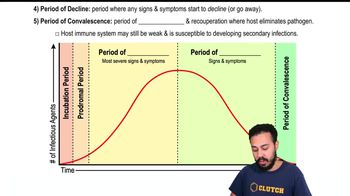
Put the following in the correct order to describe the pattern of disease: period of convalescence, prodromal period, period of decline, incubation period, period of illness.
862
views

 Guida verificata passo dopo passo
 05:36
05:36
 02:54
02:54 02:59
02:59Put the following in the correct order to describe the pattern of disease: period of convalescence, prodromal period, period of decline, incubation period, period of illness.
Use the following information to answer questions 6–7.
On September 6, a 6-year-old boy experienced fever, chills, and vomiting. On September 7, the child was hospitalized with diarrhea and swollen lymph nodes under both arms. On September 3, he had been scratched and bitten by a cat. The cat was found dead on September 5, and Y. pestis was isolated from the cat. Chloramphenicol was administered to the child from September 7, when Y. pestis was isolated from his blood. On September 17, the child's temperature returned to normal. On September 22, the child was released from the hospital
Identify the prodromal period for this disease.
a. September 3-5
b. September 3-6
c. September 6-7
d. September 6-17
Distinguish symptoms from signs as signals of disease.
Why are some organisms that constitute the normal microbiota described as commensals, whereas others are described as mutualistic?
Which one of the following diseases is not correctly matched to its reservoir?
a. Influenza-animal
b. Rabies-animal
c. Botulism-nonliving
d. Anthrax-nonliving
e. Toxoplasmosis-cats
How can a local infection become a systemic infection?