Ch. 7 - The Control of Microbial Growth
Tortora - Microbiology: An Introduction 14th Edition
Tortora14th EditionMicrobiology: An IntroductionISBN: 9780138200398Non è quello che usi tu?Cambia libro di testo
Capitolo 4, Problema 7

How do salts and sugars preserve foods? Why are these considered physical rather than chemical methods of microbial control? Name one food that is preserved with sugar and one preserved with salt. How do you account for the occasional growth of Penicillium mold in jelly, which is 50% sucrose?

Guida verificata passo dopo passo
1
Understand that salts and sugars preserve foods primarily by creating a hypertonic environment, which causes water to move out of microbial cells by osmosis, leading to dehydration and inhibition of microbial growth.
Recognize that this preservation method is considered physical rather than chemical because it relies on altering the physical environment (water availability) rather than chemically altering or killing the microbes.
Identify examples of foods preserved by sugar, such as jelly or jam, and foods preserved by salt, such as salted fish or cured meats.
Explain that despite high sugar concentration (e.g., 50% sucrose in jelly), some molds like Penicillium can occasionally grow because they are osmotolerant and can survive in low water activity environments.
Summarize that the effectiveness of salts and sugars depends on their ability to reduce water activity, which is a physical parameter, and that microbial resistance varies among different species.

Risposta video verificata per un problema simile:

Questa soluzione video è stata consigliata dai nostri tutor come utile per risolvere questo problema.
Durata del video:
2m

Concetti chiave

Ecco i concetti essenziali che devi comprendere per rispondere correttamente alla domanda.

Osmotic Pressure and Microbial Preservation

Salts and sugars preserve food by creating a hypertonic environment that draws water out of microbial cells through osmosis, leading to dehydration and inhibition of microbial growth. This reduction in available water prevents spoilage and extends shelf life without directly killing microbes.
Video consigliato:
02:37
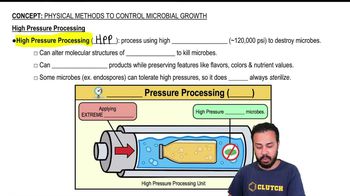
High Pressure Processing

Physical vs. Chemical Methods of Microbial Control

Physical methods inhibit microbial growth by altering environmental conditions, such as water availability, temperature, or radiation, without chemically altering microbial structures. In contrast, chemical methods involve substances that react with microbial components to kill or inhibit them. Salting and sugaring are physical because they rely on osmotic effects rather than chemical reactions.
Video consigliato:
01:46
Physical Methods to Control Microbial Growth

Microbial Growth in High Sugar or Salt Environments

Despite high sugar or salt concentrations, some microbes like Penicillium molds can occasionally grow due to their ability to tolerate lower water activity or form resistant spores. In jelly with 50% sucrose, Penicillium can survive by exploiting microenvironments or slight variations in sugar concentration, leading to spoilage.
Video consigliato:
06:30
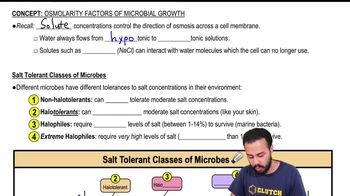
Osmolarity Factors for Microbial Growth
Pratica correlata
Domanda del libro di testo

How do autoclaving, hot air, and ultra-high-temperature pasteurization illustrate the concept of equivalent treatments?

807
views

Domanda del libro di testo

A large hospital washes burn patients in a stainless steel tub. After each patient, the tub is cleaned with a quat. It was noticed that 14 of 20 burn patients acquired Pseudomonas infections after being bathed. Provide an explanation for this high rate of infection.

728
views
Domanda del libro di testo

Use the following information to answer questions 6 and 7. The data were obtained from a use-dilution test comparing four disinfectants against Salmonella Choleraesuis.

G = growth, NG = no growth

Which disinfectant is the most effective?

916
views
Domanda del libro di testo

Which of the following is not a characteristic of quaternary ammonium compounds?

a. Bactericidal against gram-positive bacteria

b. Sporicidal

c. Amebicidal

d. Fungicidal

e. Kills enveloped viruses

1032
views
Domanda del libro di testo

The use-dilution values for two disinfectants tested under the same conditions are as follows:

Disinfectant A—1:2

Disinfectant B—1:10,000.

If both disinfectants are designed for the same purpose, which would you select?

66
views
Domanda del libro di testo

Use the following information to answer questions 6 and 7. The data were obtained from a use-dilution test comparing four disinfectants against Salmonella Choleraesuis.

G = growth, NG = no growth

Which disinfectant(s) is (are) bactericidal?

a. A,B,C, and D

b. A,C, and D

c. A only

d. B only

e. None of the above

682
views