
Ch. 7 - The Control of Microbial Growth
Tortora - Microbiology: An Introduction 14th Edition
Tortora14th EditionMicrobiology: An IntroductionISBN: 9780138200398Non è quello che usi tu?Cambia libro di testo
Capitolo 4, Problema 7

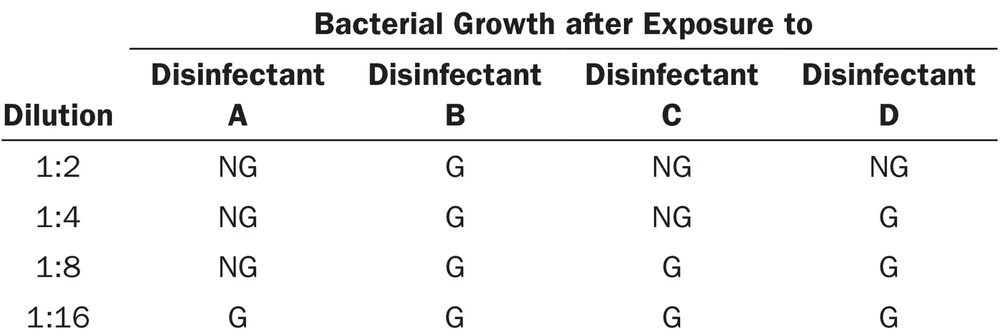
Use the following information to answer questions 6 and 7. The data were obtained from a use-dilution test comparing four disinfectants against Salmonella Choleraesuis.
G = growth, NG = no growth
Table showing bacterial growth (G) or no growth (NG) of Salmonella after exposure to four disinfectants at different dilutions.
Which disinfectant(s) is (are) bactericidal?
a. A,B,C, and D
b. A,C, and D
c. A only
d. B only
e. None of the above

Guida verificata passo dopo passo
1
Understand the difference between bactericidal and bacteriostatic agents: bactericidal disinfectants kill bacteria, resulting in no growth when cultured, while bacteriostatic disinfectants only inhibit growth temporarily.
Review the dilution test data for each disinfectant against Salmonella Choleraesuis, focusing on the presence or absence of bacterial growth (G = growth, NG = no growth) at various concentrations.
Identify which disinfectants show 'no growth' (NG) at the lowest dilution or concentration, indicating that they effectively kill the bacteria rather than just inhibiting growth.
Confirm that the disinfectants classified as bactericidal consistently show no bacterial growth across the tested dilutions, ensuring that the effect is due to killing rather than temporary inhibition.
Based on this analysis, select the disinfectant(s) that meet the criteria for being bactericidal from the given options.

Risposta video verificata per un problema simile:

Questa soluzione video è stata consigliata dai nostri tutor come utile per risolvere questo problema.
Durata del video:
3m

Concetti chiave

Ecco i concetti essenziali che devi comprendere per rispondere correttamente alla domanda.

Bactericidal vs. Bacteriostatic Agents

Bactericidal agents kill bacteria outright, resulting in no growth when cultured after treatment. In contrast, bacteriostatic agents inhibit bacterial growth but do not kill the bacteria, allowing growth to resume once the agent is removed. Understanding this distinction is key to interpreting disinfectant efficacy.
Video consigliato:
04:14
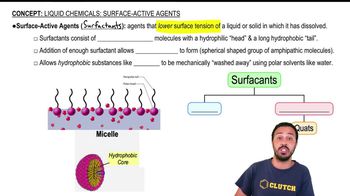
Liquid Chemicals: Surface-Active Agents

Use-Dilution Test Method

The use-dilution test measures the effectiveness of disinfectants by exposing bacteria to different dilutions of the agent and then assessing growth. No growth (NG) indicates effective killing or inhibition at that dilution, while growth (G) indicates survival. This test helps determine whether a disinfectant is bactericidal.
Video consigliato:
06:59
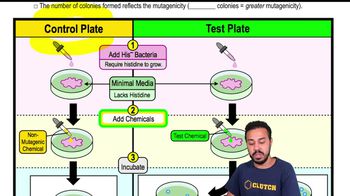
The Ames Test

Interpreting Growth Data in Microbial Testing

Interpreting results from microbial tests requires understanding that 'no growth' means the bacteria were killed or inhibited, while 'growth' means survival. For a disinfectant to be considered bactericidal, it must show no growth at the tested concentration, confirming bacterial death rather than just inhibition.
Video consigliato:
04:56
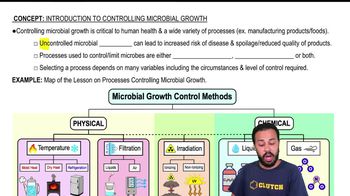
Introduction to Controlling Microbial Growth
Pratica correlata
Domanda del libro di testo

How do salts and sugars preserve foods? Why are these considered physical rather than chemical methods of microbial control? Name one food that is preserved with sugar and one preserved with salt. How do you account for the occasional growth of Penicillium mold in jelly, which is 50% sucrose?

1351
views
Domanda del libro di testo

How do autoclaving, hot air, and ultra-high-temperature pasteurization illustrate the concept of equivalent treatments?

807
views
Domanda del libro di testo

A bacterial culture was in log phase in the following figure. At time x, an antibacterial compound was added to the culture. Draw the lines indicating the addition of a bactericidal compound and a bacteriostatic compound. Explain why the viable count does not immediately drop to zero at x.

1470
views
Domanda del libro di testo

Use the following information to answer questions 6 and 7. The data were obtained from a use-dilution test comparing four disinfectants against Salmonella Choleraesuis.

G = growth, NG = no growth

Which disinfectant is the most effective?

916
views
Domanda del libro di testo

Which of the following is not a characteristic of quaternary ammonium compounds?

a. Bactericidal against gram-positive bacteria

b. Sporicidal

c. Amebicidal

d. Fungicidal

e. Kills enveloped viruses

1032
views
Domanda del libro di testo

The use-dilution values for two disinfectants tested under the same conditions are as follows:

Disinfectant A—1:2

Disinfectant B—1:10,000.

If both disinfectants are designed for the same purpose, which would you select?

66
views