Ch. 7 - The Control of Microbial Growth
Tortora - Microbiology: An Introduction 14th Edition
Tortora14th EditionMicrobiology: An IntroductionISBN: 9780138200398Non è quello che usi tu?Cambia libro di testo
Capitolo 4, Problema 1

Which of the following does not kill endospores?
a. Autoclaving
b. Incineration
c. Hot-air sterilization
d. Pasteurization
e. All of the above kill endospores

Guida verificata passo dopo passo
1
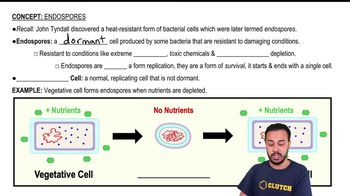
Step 1: Understand what endospores are — they are highly resistant structures formed by certain bacteria to survive extreme conditions, including heat, desiccation, and chemicals.
Step 2: Review each method's ability to kill endospores: Autoclaving uses pressurized steam at high temperatures, which is known to effectively kill endospores.
Step 3: Incineration involves burning at very high temperatures, which destroys all microbial life including endospores.
Step 4: Hot-air sterilization uses dry heat at high temperatures for a longer time and is also effective against endospores.
Step 5: Pasteurization involves heating to moderate temperatures for a short time, primarily to reduce microbial load but does not reliably kill endospores.

Risposta video verificata per un problema simile:

Questa soluzione video è stata consigliata dai nostri tutor come utile per risolvere questo problema.
Durata del video:
2m

Concetti chiave

Ecco i concetti essenziali che devi comprendere per rispondere correttamente alla domanda.

Endospore Resistance

Endospores are highly resistant dormant structures formed by some bacteria to survive extreme conditions. They can withstand heat, desiccation, chemicals, and radiation, making them difficult to kill with standard sterilization methods.
Video consigliato:
05:35
Endospores

Sterilization Methods and Their Efficacy

Different sterilization techniques vary in their ability to kill microorganisms. Autoclaving uses pressurized steam to achieve high temperatures that destroy endospores, while incineration burns them completely. Hot-air sterilization requires longer exposure at high temperatures to kill spores effectively.
Video consigliato:
05:16
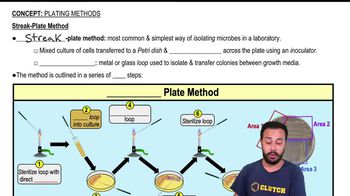
Streak-Plate Method

Pasteurization and Its Limitations

Pasteurization involves heating liquids to moderate temperatures to reduce microbial load but does not reach levels sufficient to kill endospores. It is primarily used to destroy vegetative pathogens, not the highly resistant endospores.
Video consigliato:
03:50
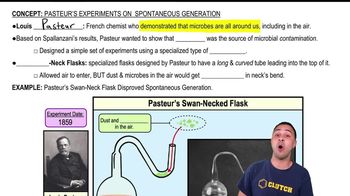
Pasteur's Experiments on Spontaneous Generation