 Indietro
Acids, Bases, Functional Groups, and Intermolecular Forces in Organic Chemistry
Guida di studio - Note intelligenti
 Appunti personalizzati basati sui tuoi materiali, ampliati con definizioni chiave, esempi e contesto.
Acids and Bases; Functional Groups
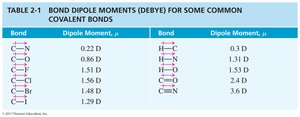
Bond Dipole Moments
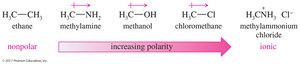
Bond dipole moments arise from differences in electronegativity between atoms in a covalent bond. The dipole moment depends on both the magnitude of charge separation and the distance between the charges. Dipole moments are measured in debyes (D).
Electronegativity: The ability of an atom to attract electrons in a bond.
Dipole Moment Formula: where is the charge and is the distance.
Measurement: 1 debye (D) = coulomb-meters.
Molecular Dipole Moment
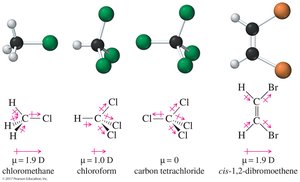
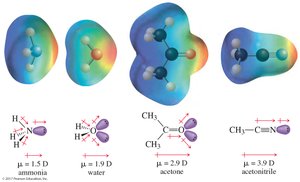
The molecular dipole moment is the vector sum of all individual bond dipole moments in a molecule. It is influenced by bond polarity, bond angles, and the presence of lone pairs of electrons.
Bond Polarity: Determined by the difference in electronegativity between bonded atoms.
Lone Pairs: Contribute to the overall dipole moment.
Geometry: The spatial arrangement of bonds affects the net dipole.
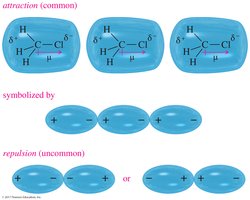
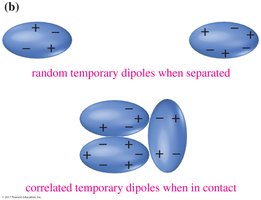
Intermolecular Forces
Intermolecular forces are attractions between molecules that influence physical properties such as melting point, boiling point, and solubility. They are classified as:
Dipole–Dipole Forces: Attraction between polar molecules.
London Dispersion Forces: Temporary dipoles in nonpolar molecules.
Hydrogen Bonding: Strong dipole–dipole attraction involving N—H or O—H groups.
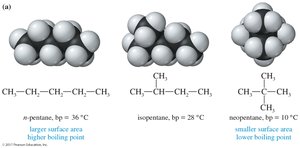
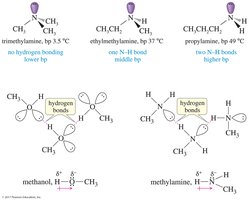
Boiling Points and Intermolecular Forces
Hydrogen bonding significantly increases the boiling point of molecules. Alcohols (O—H) have stronger hydrogen bonding than amines (N—H), resulting in higher boiling points.
Ethanol: Boiling point = 78°C
Ethyl amine: Boiling point = 17°C
Dimethyl ether: Boiling point = –25°C
Polarity Effects on Solubility
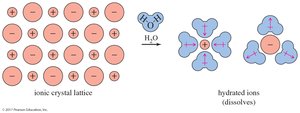
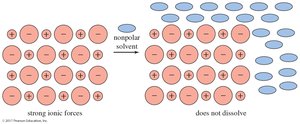
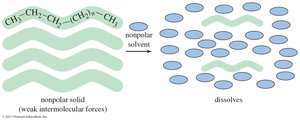
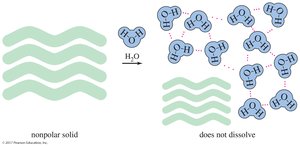
Solubility is governed by the principle "like dissolves like." Polar solutes dissolve in polar solvents, and nonpolar solutes dissolve in nonpolar solvents. Molecules with similar intermolecular forces mix freely.
Polar Solute in Polar Solvent: Hydration releases energy and increases entropy.
Polar Solute in Nonpolar Solvent: Polar solids do not dissolve in nonpolar solvents.
Nonpolar Solute in Nonpolar Solvent: Nonpolar substances dissolve due to weak attractions.
Nonpolar Solute with Polar Solvent: Nonpolar substances do not dissolve in water.
Soap and Micelles
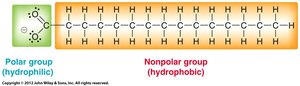
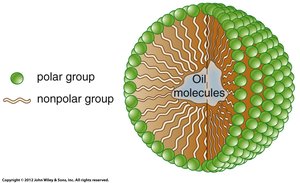
Soap molecules organize into micelles in water, forming a nonpolar interior that carries away dirt. The polar exterior interacts with water, while the nonpolar interior traps oils and grease.
Micelle: Spherical structure with hydrophilic exterior and hydrophobic interior.
Application: Used to remove nonpolar oils and dirt from surfaces.
Acid and Base Definitions
Arrhenius Acids and Bases
Arrhenius acids dissociate in water to produce hydronium ions (), while Arrhenius bases dissociate to produce hydroxide ions ().
Stronger acids: Dissociate more completely.
Stronger bases: Dissociate more completely.



Brønsted–Lowry Acids and Bases
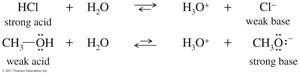
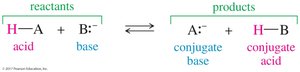
Brønsted–Lowry acids are proton donors, and Brønsted–Lowry bases are proton acceptors. Acid-base reactions involve the transfer of a proton.
Conjugate Acid: Formed when a base accepts a proton.
Conjugate Base: Formed when an acid donates a proton.

Acid and Base Strength
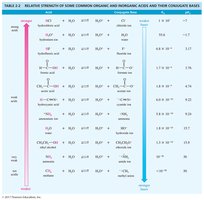
The strength of an acid is expressed by its extent of ionization in water. The strength of an acid is inversely related to the strength of its conjugate base.
Strong Acid: Weak conjugate base.
Weak Acid: Strong conjugate base.

Equilibrium Positions of Acid–Base Reactions
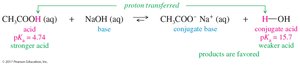
Acid–base equilibrium favors the formation of the weaker acid and the weaker base. The weaker acid has a larger pKa, and the weaker base has a larger pKb. Both are always on the same side of the equation.
pKa:
pKb:

Solvent Effects on Acidity and Basicity
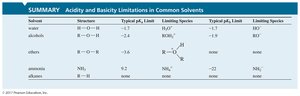
Water is amphoteric, meaning it can act as both an acid and a base. Its conjugate acid is the hydronium ion, and its conjugate base is the hydroxide ion.
Amphoteric: Can react with both acids and bases.
Limiting Species: The strongest acid or base that can exist in a given solvent.

Factors Affecting Acid Strength
Electronegativity
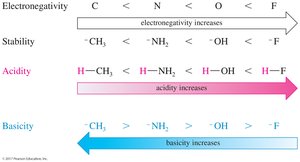
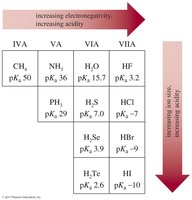
A more electronegative element stabilizes a negative charge more easily, resulting in a more stable conjugate base and a stronger acid.
Acidity increases: With increasing electronegativity.
Basicity decreases: With increasing electronegativity.
Size
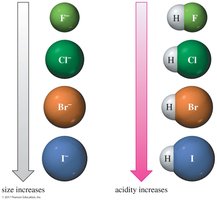
The negative charge of an anion is more stable if it is spread over a larger region of space. Within a column of the periodic table, acidity increases down the column.
Acidity increases: As atom size increases.
Inductive Effects
Electron-withdrawing atoms and groups stabilize a conjugate base through sigma bonds. The effect depends on the number of bonds between the electronegative element and the site of the negative charge.
Multiple electron-withdrawing groups: Increase acidity more than a single group.



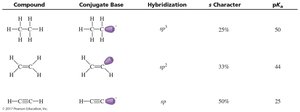
Hybridization Effects
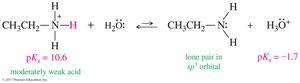
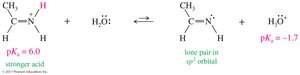
The hybridization state of an atom affects acidity. Greater s-character in the hybrid orbital increases acidity.
sp3: Least acidic
sp2: More acidic
sp: Most acidic
Resonance Effects
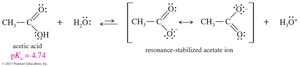
If the negative charge on an atom can be delocalized over two or more atoms, the acidity of that compound will be greater. Resonance stabilization increases acidity.
Acetate ion: More acidic due to resonance.
Methanesulfonic acid: Even more acidic due to multiple resonance forms.

Lewis Acids and Bases
Definitions
Lewis bases (nucleophiles) are species with available electrons that can be donated to form a new bond. Lewis acids (electrophiles) are species that can accept these electrons to form new bonds.
Nucleophile: Donates electrons to a nucleus with an empty orbital.
Electrophile: Accepts a pair of electrons.
Classes of Organic Compounds
Hydrocarbons
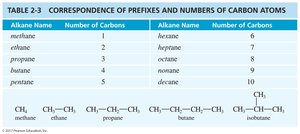
Hydrocarbons are compounds composed only of carbon and hydrogen. They are classified based on the types of bonds present:
Alkanes: Single bonds, all carbons are sp3 hybridized.
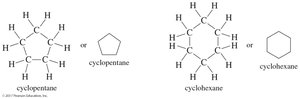
Cycloalkanes: sp3 carbons form a ring.
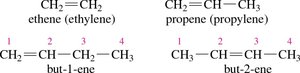
Alkenes: Double bonds, sp2 carbons.
Cycloalkenes: Double bond in a ring.
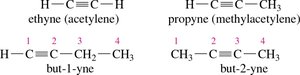
Alkynes: Triple bonds, sp carbons.
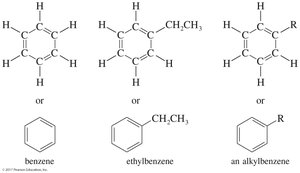
Aromatic: Contain a benzene ring.
Compounds Containing Oxygen
Alcohols: Contain the hydroxyl group (—OH).
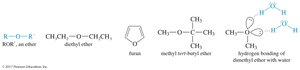
Ethers: Two alkyl groups bonded to an oxygen atom.
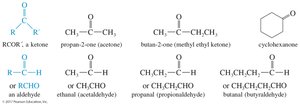
Aldehydes and Ketones: Contain the carbonyl group (C=O).
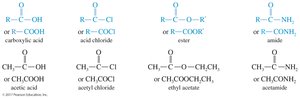
Carboxylic Acids: Contain the carboxyl group (—COOH).
Carboxylic Acid Derivatives: Acid chlorides, esters, and amides.


Compounds Containing Nitrogen
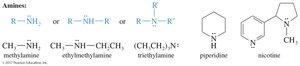
Amines: Alkylated derivatives of ammonia.
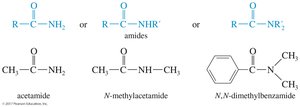
Amides: Carboxylic acid derivative with nitrogen attached to the carbonyl group.
Nitriles: Contain the cyano group.
Nitriles
Nitriles are compounds containing the cyano group (—C≡N).
Structure: Carbon triple-bonded to nitrogen.
Example: Acetonitrile (CH3CN).
