Ch. 12 - Radicals
Bruice - Organic Chemistry 8th Edition
Bruice8th EditionOrganic ChemistryISBN: 9780135213711Non è quello che usi tu?Cambia libro di testo
Capitolo 12, Problema 46f

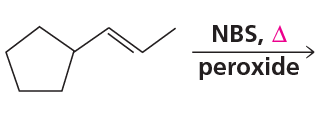
Draw the products of the following reactions, including all stereoisomers:
f. Chemical structure showing allylic bromination with NBS and peroxide, indicating reaction products and stereoisomers.

Guida verificata passo dopo passo
1
Step 1: Recognize the reaction type. The reaction involves NBS (N-Bromosuccinimide) in the presence of heat (Δ) and peroxide. This is a radical bromination reaction that selectively brominates allylic positions due to the stability of the allylic radical.
Step 2: Identify the allylic position in the given molecule. The allylic position is the carbon atom adjacent to the double bond. In this case, the allylic position is the carbon atom directly connected to the double bond in the side chain.
Step 3: Generate the allylic radical intermediate. The peroxide initiates the formation of a bromine radical, which abstracts a hydrogen atom from the allylic position, forming a stable allylic radical.
Step 4: Add the bromine atom to the allylic radical. The bromine radical reacts with the allylic radical to form the brominated product at the allylic position.
Step 5: Consider stereoisomers. Since the allylic position is not a stereocenter in this molecule, no stereoisomers are formed. The product will be a single brominated compound at the allylic position.

Risposta video verificata per un problema simile:

Questa soluzione video è stata consigliata dai nostri tutor come utile per risolvere questo problema.
Durata del video:
5m

Concetti chiave

Ecco i concetti essenziali che devi comprendere per rispondere correttamente alla domanda.

Allylic Bromination

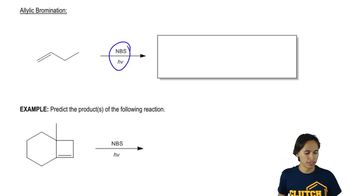
Allylic bromination is a reaction where bromine is added to the allylic position of an alkene, typically using N-bromosuccinimide (NBS) in the presence of a peroxide. This reaction proceeds via a radical mechanism, where the allylic hydrogen is abstracted, forming a resonance-stabilized radical that can then react with bromine to yield brominated products.
Video consigliato:
00:54
Mechanism of Allylic Bromination.

Radical Mechanism

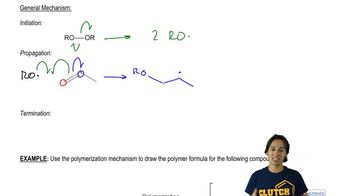
A radical mechanism involves the formation and reaction of free radicals, which are highly reactive species with unpaired electrons. In the context of allylic bromination, the reaction starts with the generation of a radical intermediate through the homolytic cleavage of a bond, allowing for subsequent reactions that lead to the formation of products, including stereoisomers.
Video consigliato:
03:28
The mechanism of Radical Polymerization.

Stereoisomerism

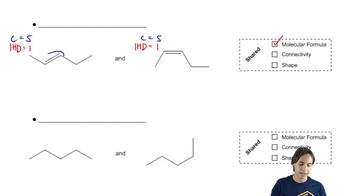
Stereoisomerism refers to the existence of compounds with the same molecular formula and connectivity but different spatial arrangements of atoms. In the case of allylic bromination, the formation of stereoisomers occurs due to the different orientations of substituents around the double bond, leading to distinct products that must be accounted for when drawing the final reaction products.
Video consigliato:
01:58
Determining when molecules are stereoisomers.