Indietro
 Bruice 8th EditionCh. 6 - The Reactions of Alkenes • The Stereochemistry of Addition Reactions
Problema 35
What characteristics must the reactant of a stereospecific reaction have?
Problema 36a,b,c
a. Is the reaction of 2-butene with HBr regioselective?
b. Is it stereoselective?
c. Is it stereospecific?
Problema 36d,e,f
d. Is the reaction of 1-butene with HBr regioselective?
e. Is it stereoselective?
f. Is it stereospecific?
Problema 37b
What stereoisomers are obtained from each of the following reactions?
b.
Problema 40
a. What stereoisomers are formed in the following reaction? Are they enantiomers or diastereomers?
b. Which stereoisomer is formed in greater yield?
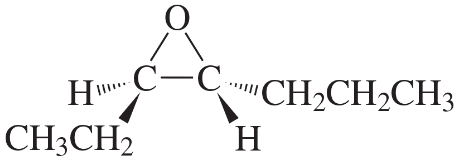
Problema 41(1)
a. What alkene is required to synthesize each of the following compounds?
b. What other epoxide is formed in each synthesis?
c. Assign an R or S configuration to each asymmetric center.
1.
Problema 41(2)
a. What alkene is required to synthesize each of the following compounds?
b. What other epoxide is formed in each synthesis?
c. Assign an R or S configuration to each asymmetric center.
2.
Problema 42a,b
What stereoisomers are obtained from hydroboration–oxidation of the following compounds? Assign an R or S configuration to each asymmetric center.
a. cyclohexene
b. 1-ethylcyclohexene
Problema 42c
What stereoisomers are obtained from hydroboration–oxidation of the following compounds? Assign an R or S configuration to each asymmetric center.
c. cis-2-butene
Problema 42d
What stereoisomers are obtained from hydroboration–oxidation of the following compounds? Assign an R or S configuration to each asymmetric center.
d. (Z)-3,4-dimethyl-3-hexene
Problema 43
The reaction of 2-ethyl-1-pentene with Br2, with H2 + Pd/C, or with R2BH/THF followed by aqueous HO- + H2O2 leads to a racemic mixture. Explain why a racemic mixture is obtained in each case.
Problema 44
Using a sample of trans-2-pentene, how could you prove that the addition of Br2 forms a cyclic bromonium ion intermediate rather than a carbocation intermediate?
Problema 45c,d
What stereoisomers are obtained from the following reactions?
c. (E)-3-methyl-2-pentene + HBr
d. cis-3-hexene + HBr
Problema 46
When Br2 adds to a cis alkene that has different substituents attached to each of the two sp2 carbons, such as cis-2-heptene, identical amounts of the two threo enantiomers are obtained even though Br- is more likely to add to the less sterically hindered carbon of the bromonium ion. Explain why identical amounts of the two enantiomers are obtained.
Problema 49c,d
What stereoisomers would you expect to obtain from each of the following reactions?
c.
d.
Problema 50
a. What is the major product obtained from the reaction of propene and Br2 plus excess Cl-?
b. Indicate the relative amounts of the stereoisomers that are obtained.
Problema 51b
What is the product of the reaction of maleate and H2O when H2SO4 is used as a catalyst instead of fumarase?
Problema 53a
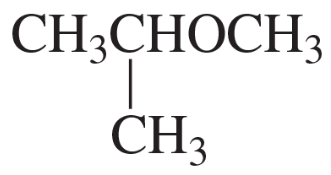
Show how each of the following compounds can be synthesized from an alkene:
a.
Problema 53b
Show how each of the following compounds can be synthesized from an alkene:
b.
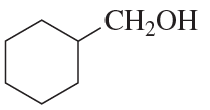
Problema 53c
Show how each of the following compounds can be synthesized from an alkene:
c.
Problema 54
Explain why 3-methylcyclohexene should not be used as the starting material in Problem 52b.
Problema 56a
Which electrophilic addition reactions
a. form a carbocation intermediate? intermediate?
Problema 56c
Which electrophilic addition reactions
c. form a three-membered ring
Problema 56d
Which electrophilic addition reactions
d. form a five-membered ring intermediate?
Problema 57a
Identify the electrophile and the nucleophile in each of the following reaction steps and then draw curved arrows to illustrate the bond-making and bondbreaking processes.
a.
Problema 57b
Identify the electrophile and the nucleophile in each of the following reaction steps and then draw curved arrows to illustrate the bond-making and bondbreaking processes.
b.
Problema 57c
Identify the electrophile and the nucleophile in each of the following reaction steps and then draw curved arrows to illustrate the bond-making and bondbreaking processes.
c.
Problema 58a
What is the major product of the reaction of 2-methyl-2-butene with each of the following reagents?
a. HBr
Problema 58b
What is the major product of the reaction of 2-methyl-2-butene with each of the following reagents?
b. HI
Problema 58d
What is the major product of the reaction of 2-methyl-2-butene with each of the following reagents?
d. O3, −78 °C, followed by (CH3)2S