Indietro
 Bruice 8th EditionCh. 8 - Delocalized Electrons: Their Effect on Stability, pKa, and the Products of a Reaction • Aromaticity and Electronic Effects: An Introduction to the Reactions of Benzene
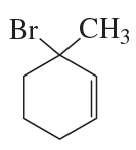
Problema 90(1)
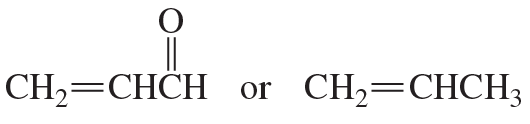
a. How could each of the following compounds be prepared from a hydrocarbon in a single step?
b. What other organic compound would be obtained from each synthesis?
1.
Problema 90(2)
a. How could each of the following compounds be prepared from a hydrocarbon in a single step?
b. What other organic compound would be obtained from each synthesis?
2.
Problema 91
Draw the products obtained from the reaction of one equivalent of HBr with one equivalent of 1,3,5-hexatriene.
a. Which product(s) will predominate if the reaction is under kinetic control?
b. Which product(s) will predominate if the reaction is under thermodynamic control?
Problema 92a
How would the following substituents affect the rate of a Diels–Alder reaction?
a. an electron-donating substituent in the diene
Problema 92b
How would the following substituents affect the rate of a Diels–Alder reaction?
b. an electron-donating substituent in the dienophile
Problema 92c
How would the following substituents affect the rate of a Diels–Alder reaction?
c. an electron-withdrawing substituent in the diene
Problema 94a
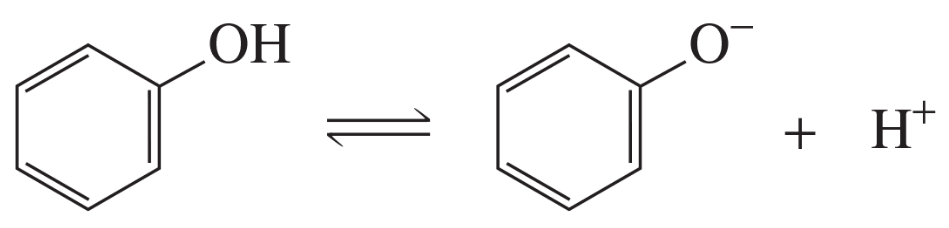
The acid dissociation constant (Ka) for loss of a proton from cyclohexanol is 1 × 10–16.
a. Draw a reaction coordinate diagram for loss of a proton from cyclohexanol.
Problema 94b
Draw the resonance contributors for phenol.
Problema 94c
Draw the resonance contributors for the phenolate ion.
Problema 94e,f
e. Which has a greater Ka: cyclohexanol or phenol?
f. Which is a stronger acid: cyclohexanol or phenol?
Problema 95e,f
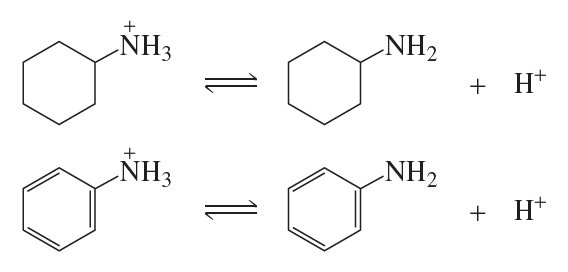
Protonated cyclohexylamine has a Ka = 1 * 10-11. Using the same sequence of steps as in Problem 94, determine which is a stronger base: cyclohexylamine
or aniline.
e. Which has a greater Ka: cyclohexylammmonium ion or anilinium ion?
f. Which is a stronger acid: cyclohexylamine or aniline?
Problema 98a(1)
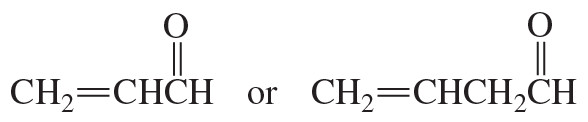
Which dienophile in each pair is more reactive in a Diels–Alder reaction?
1.
Problema 98a(2)
Which dienophile in each pair is more reactive in a Diels–Alder reaction?
2.
Problema 99b
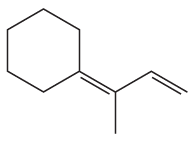
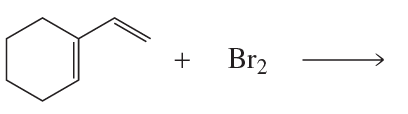
Draw the major products obtained from the reaction of one equivalent of HBr with the following compounds. For each reaction, indicate the kinetic product and the thermodynamic product.
b.
Problema 100
Cyclopentadiene can react with itself in a Diels–Alder reaction. Draw the endo and exo products.
Problema 101e
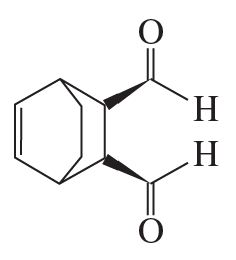
Which diene and which dienophile could be used to prepare each of the following?
e.
Problema 102a
Propose a mechanism for the following reaction:
Problema 102b
What is the product of the following reaction?
Problema 103a
What are the products of the following reaction?
Problema 103b
How many stereoisomers of each product could be obtained?
Problema 104
As many as 18 different Diels–Alder products can be obtained by heating a mixture of 1,3-butadiene and 2-methyl-1,3-butadiene. Identify the products.
Problema 105
On a single graph, draw the reaction coordinate diagram for the addition of one equivalent of HBr to 2-methyl-1,3-pentadiene and for the addition of one equivalent of HBr to 2-methyl-1,4-pentadiene. Which reaction is faster?
Problema 106
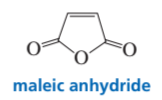
While attempting to recrystallize maleic anhydride, a student dissolved it in freshly distilled cyclopentadiene rather than in freshly distilled cyclopentane. Was her recrystallization successful?
Problema 108
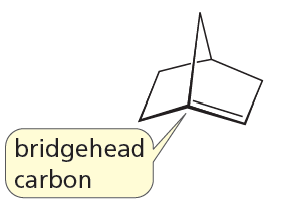
In 1935, J. Bredt, a German chemist, proposed that a bicycloalkene could not have a double bond at a bridgehead carbon unless one of the rings contains at least eight carbons. This is known as Bredt's rule. Explain why there cannot be a double bond at this position.
Problema 109a
The experiment shown next and discussed in Section 8.13 shows that the proximity of the chloride ion to C-2 in the transition state causes the 1,2-addition product to form more rapidly than the 1,4-addition product.
a. Why was it important for the investigators to know that the preceding reaction was being carried out under kinetic control?
Problema 110
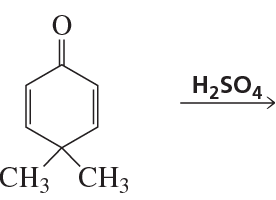
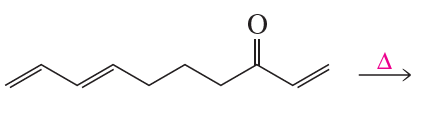
Identify the product of the following reaction.
Problema 111a
Draw the resonance contributors of the cyclooctatrienyl dianion.
a. Which of the resonance contributors is the least stable?
Problema 111b
Draw the resonance contributors of the cyclooctatrienyl dianion.
b. Which of the resonance contributors makes the smallest contribution to the hybrid?