
Ch. 8 - Delocalized Electrons: Their Effect on Stability, pKa, and the Products of a Reaction • Aromaticity and Electronic Effects: An Introduction to the Reactions of Benzene
Bruice - Organic Chemistry 8th Edition
Bruice8th EditionOrganic ChemistryISBN: 9780135213711Non è quello che usi tu?Cambia libro di testo
Capitolo 8, Problema 94c

Draw the resonance contributors for the phenolate ion.

Guida verificata passo dopo passo
1
Identify the phenolate ion structure: The phenolate ion consists of a benzene ring with an oxygen atom attached to it, carrying a negative charge. This negative charge is delocalized across the aromatic ring through resonance.
Draw the first resonance contributor: Start with the phenolate ion where the negative charge is localized on the oxygen atom. Represent the lone pairs on oxygen and the aromatic ring with alternating double bonds.
Move the negative charge into the ring: Use curved arrows to show the movement of electrons. One lone pair from the oxygen forms a double bond with the adjacent carbon, while the double bond in the ring shifts to the next position, creating a new resonance structure.
Repeat the electron movement: Continue moving the negative charge around the ring by shifting the double bonds. Each time, the negative charge will appear on a different carbon atom in the ring, creating additional resonance contributors.
Verify all resonance contributors: Ensure that all resonance structures obey the rules of resonance (e.g., maintaining the aromaticity of the benzene ring and proper placement of charges). The negative charge should be delocalized across the ring in all contributors.

Risposta video verificata per un problema simile:

Questa soluzione video è stata consigliata dai nostri tutor come utile per risolvere questo problema.
Durata del video:
5m

Concetti chiave

Ecco i concetti essenziali che devi comprendere per rispondere correttamente alla domanda.

Resonance Structures

Resonance structures are different Lewis structures for the same molecule that depict the delocalization of electrons. In the case of the phenolate ion, resonance allows for the distribution of negative charge across the aromatic ring, stabilizing the ion. Each resonance contributor represents a possible arrangement of electrons, but the actual structure is a hybrid of all contributors.
Video consigliato:
03:04
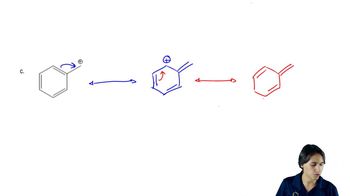
Drawing Resonance Structures

Aromaticity

Aromaticity refers to the enhanced stability of certain cyclic compounds due to the delocalization of π electrons across the ring. For phenolate, the aromatic ring maintains its stability even when a negative charge is present, allowing for resonance contributors that involve the movement of electrons while preserving the aromatic character of the benzene ring.
Video consigliato:
08:19
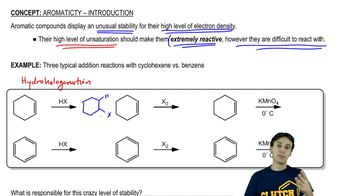
Intro to Aromaticity

Phenolate Ion

The phenolate ion is the conjugate base of phenol, formed when phenol loses a proton (H+). This ion features a negative charge on the oxygen atom, which can be delocalized into the aromatic ring through resonance. Understanding the structure and behavior of the phenolate ion is crucial for predicting its reactivity and interactions in organic reactions.
Video consigliato:
02:27
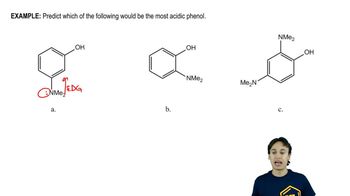
Identify the most acidic phenol