



Ch. 9 - Substitution and Elimination Reactions of Alkyl Halides
Bruice - Organic Chemistry 8th Edition
Bruice8th EditionOrganic ChemistryISBN: 9780135213711Non è quello che usi tu?Cambia libro di testo
Capitolo 9, Problema 30a,b

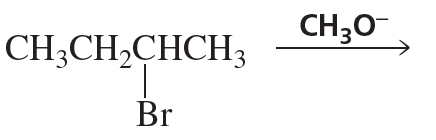
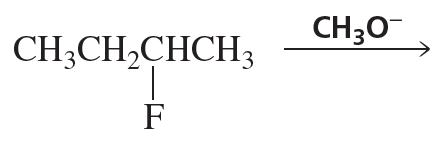
For each of the following reactions, (1) decide whether an E2 or an E1 occurs, and (2) draw the major elimination product:
a. Chemical structure showing a brominated alkane reacting with methoxide, indicating elimination reaction pathways.
b. Chemical structure diagram showing an alkyl halide with a fluorine atom and a hydroxide ion, indicating elimination reactions.

Guida verificata passo dopo passo
1
Step 1: Analyze the reaction conditions for both (i) and (ii). The presence of CH3O⁻ (methoxide ion) indicates a strong base, which favors the E2 elimination mechanism over E1. E2 is a one-step process where the base abstracts a proton and the leaving group departs simultaneously.
Step 2: For reaction (i), identify the leaving group (Br) and the β-hydrogens on the adjacent carbons. The major elimination product will be determined by the Zaitsev rule, which states that the more substituted alkene is favored.
Step 3: For reaction (ii), identify the leaving group (F) and the β-hydrogens on the adjacent carbons. Fluorine is a poor leaving group compared to bromine, but under strong base conditions, E2 elimination can still occur. Apply the Zaitsev rule to determine the major product.
Step 4: Draw the major elimination product for both reactions. For (i), the double bond will form between the carbon with the leaving group and the β-carbon with the most substituents. For (ii), follow the same logic to place the double bond in the most substituted position.
Step 5: Confirm the stereochemistry of the products. In E2 reactions, the β-hydrogen and the leaving group must be anti-periplanar (opposite sides of the molecule). Ensure the drawn products reflect this geometry.

Risposta video verificata per un problema simile:

Questa soluzione video è stata consigliata dai nostri tutor come utile per risolvere questo problema.
Durata del video:
5m

Concetti chiave

Ecco i concetti essenziali che devi comprendere per rispondere correttamente alla domanda.

E1 and E2 Mechanisms

E1 and E2 are two types of elimination reactions in organic chemistry. E1 reactions are unimolecular and involve a two-step mechanism where the leaving group departs first, forming a carbocation intermediate, followed by deprotonation. E2 reactions are bimolecular and occur in a single concerted step, where the base abstracts a proton while the leaving group exits simultaneously, leading to the formation of a double bond.
Video consigliato:
09:36
Drawing the E2 Mechanism.

Substrate Structure and Stability

The structure of the substrate plays a crucial role in determining whether an E1 or E2 mechanism will occur. E1 reactions are favored by tertiary substrates due to the stability of the carbocation formed, while E2 reactions can occur with primary, secondary, or tertiary substrates, depending on the strength of the base and steric hindrance. Understanding the substrate's structure helps predict the reaction pathway.
Video consigliato:
03:43
The radical stability trend.

Regioselectivity and Stereochemistry

Elimination reactions can lead to different products based on regioselectivity and stereochemistry. Regioselectivity refers to the preference for the formation of one constitutional isomer over another, while stereochemistry involves the spatial arrangement of atoms in the product. In E2 reactions, the anti-periplanar arrangement of the leaving group and the hydrogen being removed is crucial for the formation of the double bond, influencing the final product's stereochemistry.
Video consigliato:
Percorso guidato
1:38
Polymer Stereochemistry Concept 1