Ch. 10 - Alkynes: Electrophilic Addition and Redox Reactions
Mullins - Organic Chemistry: A Learner Centered Approach 1st Edition
Mullins1st EditionOrganic Chemistry: A Learner Centered ApproachISBN: 9780137566471Non è quello che usi tu?Cambia libro di testo
Capitolo 9, Problema 44c(v)

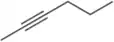
For the alkynes shows here, show the product(s) expected to form when treated under the following conditions: (v) HCl (2 equiv.). If you expect two products, show both.
(c) Diagram of alkynes showing expected products from hydrogenation with H₂ and Pd/C catalyst.

Guida verificata passo dopo passo
1
Identify the structure of the alkyne provided in the problem. Alkynes are hydrocarbons containing a carbon-carbon triple bond (C≡C). Determine whether the alkyne is terminal (triple bond at the end of the chain) or internal (triple bond within the chain).
Understand the reaction conditions: HCl (2 equivalents). This indicates that the alkyne will undergo two successive electrophilic addition reactions with HCl, where the π-bonds of the triple bond will react with HCl molecules.
In the first step, the π-electrons of the triple bond attack the hydrogen atom of HCl, forming a carbocation intermediate. Use Markovnikov's rule to determine the regioselectivity of the addition: the hydrogen atom will add to the carbon of the triple bond that already has more hydrogens, and the chlorine atom will add to the other carbon.
In the second step, the remaining π-bond of the double bond (formed after the first addition) reacts with another molecule of HCl. Again, apply Markovnikov's rule to determine the placement of the second chlorine atom. This results in a geminal dihalide (both chlorine atoms attached to the same carbon).
If the alkyne is symmetrical, only one product will form. If the alkyne is asymmetrical, two regioisomeric products may form depending on the placement of the substituents around the triple bond. Draw the final product(s) based on the structure of the starting alkyne and the reaction mechanism described.

Risposta video verificata per un problema simile:

Questa soluzione video è stata consigliata dai nostri tutor come utile per risolvere questo problema.
Durata del video:
6m

Concetti chiave

Ecco i concetti essenziali che devi comprendere per rispondere correttamente alla domanda.

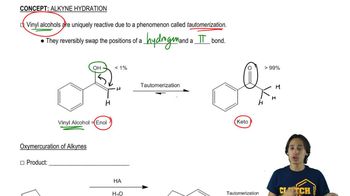
Alkynes

Alkynes are hydrocarbons that contain at least one carbon-carbon triple bond. They are unsaturated compounds and can undergo various reactions, including addition reactions. The presence of the triple bond makes them more reactive than alkenes and alkanes, allowing them to react with halogens, hydrogen, and acids.
Video consigliato:
09:11
Alkyne Hydration

Electrophilic Addition

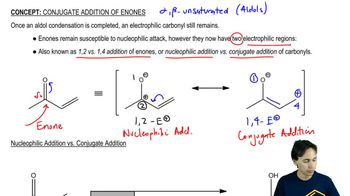
Electrophilic addition is a reaction mechanism where an electrophile reacts with a nucleophile, leading to the formation of a more saturated product. In the case of alkynes reacting with HCl, the triple bond acts as a nucleophile, attacking the electrophilic hydrogen in HCl, resulting in the addition of hydrogen and chloride across the triple bond.
Video consigliato:
09:23
1,2 vs 1,4 Addition

Markovnikov's Rule

Markovnikov's Rule states that when HX (where X is a halogen) adds to an alkene or alkyne, the hydrogen atom will attach to the carbon with the greater number of hydrogen atoms already attached. This rule helps predict the major product in reactions involving unsymmetrical reagents, leading to the formation of more stable carbocations during the reaction.
Video consigliato:
03:54
The 18 and 16 Electron Rule