
Ch. 10 - Alkynes: Electrophilic Addition and Redox Reactions
Mullins - Organic Chemistry: A Learner Centered Approach 1st Edition
Mullins1st EditionOrganic Chemistry: A Learner Centered ApproachISBN: 9780137566471Non è quello che usi tu?Cambia libro di testo
Capitolo 9, Problema 61

An alternate method for the synthesis of alkynes relies on the double elimination of H―Br from a dihaloalkane under basic conditions. Suggest a mechanism for this reaction that we discuss in Chapter 12.
Chemical reaction diagram showing double elimination of H―Br from a dihaloalkane using sodium amide to form an alkyne.

Guida verificata passo dopo passo
1
Step 1: Begin by identifying the starting material, which is a dihaloalkane. A dihaloalkane contains two halogen atoms (e.g., bromine) attached to adjacent carbon atoms in the molecule.
Step 2: Recognize that the reaction occurs under basic conditions. A strong base, such as NaNH₂ or KOH, is typically used to facilitate the elimination process. The base will abstract a proton (H⁺) from the molecule.
Step 3: In the first elimination step, the base abstracts a proton from a carbon atom adjacent to one of the halogen atoms. This leads to the formation of a carbanion intermediate. The halogen atom (e.g., Br) leaves as a halide ion (Br⁻), resulting in the formation of a double bond (alkene).
Step 4: In the second elimination step, the base abstracts another proton from the carbon atom adjacent to the remaining halogen atom. This leads to the formation of another carbanion intermediate. The second halogen atom leaves as a halide ion, resulting in the formation of a triple bond (alkyne).
Step 5: The final product is an alkyne, formed after the double elimination of H―Br from the dihaloalkane. The reaction mechanism involves two consecutive E2 elimination steps, where the base facilitates the removal of protons and halide ions to form the alkyne.

Risposta video verificata per un problema simile:

Questa soluzione video è stata consigliata dai nostri tutor come utile per risolvere questo problema.
Durata del video:
1m

Concetti chiave

Ecco i concetti essenziali che devi comprendere per rispondere correttamente alla domanda.

Alkynes and Their Synthesis

Alkynes are hydrocarbons containing at least one carbon-carbon triple bond. They can be synthesized through various methods, including the double elimination of hydrogen halides from dihaloalkanes. Understanding the structure and reactivity of alkynes is crucial for predicting the outcomes of synthetic reactions.
Video consigliato:
09:11
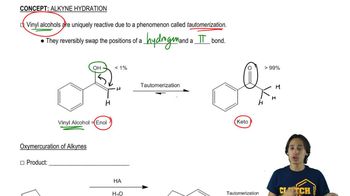
Alkyne Hydration

Dihaloalkanes

Dihaloalkanes are organic compounds that contain two halogen atoms attached to a carbon chain. Their reactivity is influenced by the nature of the halogens and the surrounding conditions. In the context of alkyne synthesis, the elimination of H-Br from a dihaloalkane is a key step that requires a strong base to facilitate the reaction.

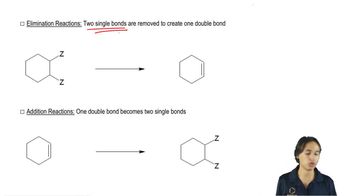
Elimination Reactions

Elimination reactions involve the removal of atoms or groups from a molecule, resulting in the formation of a double or triple bond. In this case, the double elimination of H-Br from a dihaloalkane leads to the formation of an alkyne. Understanding the mechanism of elimination reactions, including the role of bases and the formation of intermediates, is essential for predicting reaction pathways.
Video consigliato:
00:40
Recognizing Elimination Reactions.