Ch. 10 - Alkynes: Electrophilic Addition and Redox Reactions
Mullins - Organic Chemistry: A Learner Centered Approach 1st Edition
Mullins1st EditionOrganic Chemistry: A Learner Centered ApproachISBN: 9780137566471Non è quello che usi tu?Cambia libro di testo
Capitolo 9, Problema 56

When alkynes are treated with water and bromine a bromoketone is produced. Provide a plausible arrow-pushing mechanism that accounts for the formation of this product.
Chemical reaction diagram showing alkyne halogenation with Br2 and H2O producing a bromoketone.

Guida verificata passo dopo passo
1
Identify the starting material (alkyne) and the reagents (water and bromine). Recognize that the reaction involves electrophilic addition followed by nucleophilic attack and tautomerization.
In the first step, bromine (Br₂) acts as an electrophile. The π-electrons of the alkyne attack one bromine atom, forming a bromonium ion intermediate. This step involves the breaking of the Br-Br bond, leaving a bromide ion (Br⁻) as a byproduct.
Next, water (H₂O) acts as a nucleophile and attacks the more substituted carbon of the bromonium ion, opening the three-membered ring. This step results in the formation of a bromohydrin intermediate.
The bromohydrin undergoes tautomerization. The hydroxyl group (-OH) is protonated by a proton donor (e.g., H⁺), forming a good leaving group (H₂O). The adjacent carbon-carbon bond electrons shift to form a double bond, and the bromide ion (Br⁻) abstracts a proton from the neighboring carbon, resulting in the formation of a bromoketone.
Finally, confirm the product structure as a bromoketone, where the carbonyl group (C=O) is adjacent to a bromine atom. This product is stabilized due to resonance and the electron-withdrawing effect of bromine.

Risposta video verificata per un problema simile:

Questa soluzione video è stata consigliata dai nostri tutor come utile per risolvere questo problema.
Durata del video:
4m

Concetti chiave

Ecco i concetti essenziali che devi comprendere per rispondere correttamente alla domanda.

Alkynes and Their Reactivity

Alkynes are hydrocarbons containing at least one carbon-carbon triple bond. Their reactivity is significantly influenced by this triple bond, which can undergo various reactions, including electrophilic addition. Understanding the nature of alkynes is crucial for predicting how they will interact with reagents like water and bromine.
Video consigliato:
09:11
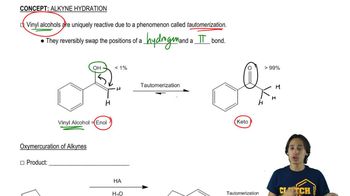
Alkyne Hydration

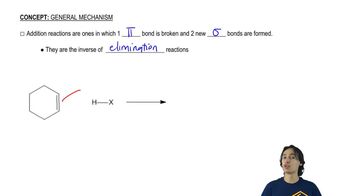
Electrophilic Addition Mechanism

Electrophilic addition is a fundamental reaction mechanism in organic chemistry where an electrophile reacts with a nucleophile, leading to the formation of a more stable product. In the case of alkynes, the triple bond acts as a nucleophile, attacking the electrophilic bromine, which initiates the mechanism that ultimately leads to the formation of a bromoketone.
Video consigliato:
05:39
Features of Addition Mechanisms.

Arrow-Pushing Notation

Arrow-pushing notation is a visual representation used to depict the movement of electrons during chemical reactions. It illustrates how electrons are transferred between atoms and bonds, helping to clarify the steps in a reaction mechanism. Mastery of this notation is essential for accurately conveying the sequence of events in the formation of products like bromoketones from alkynes.
Video consigliato:
06:20
Alternative MO Notation for Dienes
Pratica correlata
Domanda del libro di testo

An alternate method for the synthesis of alkynes relies on the double elimination of H―Br from a dihaloalkane under basic conditions. Suggest a mechanism for this reaction that we discuss in Chapter 12.

1333
views

Domanda del libro di testo

The addition of H―X to alkynes has been shown to occur predominately via anti addition:

Two chemists disagreed on whether or not anti addition would happen on terminal alkynes as well. Suggest an experiment through which you could resolve this dispute.

1323
views
Domanda del libro di testo

The synthesis of five-membered lactones (cyclic esters) has been accomplished using the electrophilic addition of I―Cl to an alkyne. Suggest a mechanism for this cyclization reaction. (Structure modification of Yao, T.; Larock, R.C. J. Org. Chem. 2005, 70, 1432–1437.)

1045
views
Domanda del libro di testo

In 1973, Caine and Tuller reported a synthesis of racemic oplapanone, a sesquiterpene isolated from Oplopanax japonicus (a deciduous shrub) involving a reaction we learned in this chapter. Predict the product of the reaction shown. (Caine, D.; Tuller, F. N. J. Org. Chem. 1973, 38, 3663.)

997
views
Domanda del libro di testo

A chemist attempted to do the following acetylide alkylation reaction but was unsuccessful in several attempts, producing only the original starting materials in each case. Explain why the reaction didn't work.

952
views
Domanda del libro di testo

Trans addition is heavily favored for the addition of Br₂ and Cl₂ to alkynes. With chlorination, however, more of the syn addition product is formed. Rationalize this fact in light of your answer to Assessments 10.50 and 10.51.

1437
views