Ch. 10 - Alkynes: Electrophilic Addition and Redox Reactions
Mullins - Organic Chemistry: A Learner Centered Approach 1st Edition
Mullins1st EditionOrganic Chemistry: A Learner Centered ApproachISBN: 9780137566471Non è quello che usi tu?Cambia libro di testo
Capitolo 9, Problema 26b

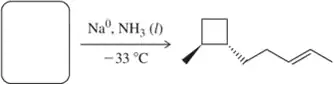
Suggest alkynes that might be used to make the following trans-alkenes.
(b) Reaction scheme showing sodium in liquid ammonia converting a square structure to a trans-alkene at -33 °C.

Guida verificata passo dopo passo
1
Identify the trans-alkene product structure. A trans-alkene has two substituents on opposite sides of the double bond. Analyze the given trans-alkene to determine the carbon chain and substituents.
Recall that alkynes can be reduced to trans-alkenes using a dissolving metal reduction, such as sodium (Na) in liquid ammonia (NH₃). This reaction selectively produces trans-alkenes from alkynes.
Determine the alkyne precursor by replacing the double bond in the trans-alkene with a triple bond. This involves identifying the corresponding alkyne structure that would yield the given trans-alkene upon reduction.
Ensure that the alkyne precursor is a terminal or internal alkyne, depending on the structure of the trans-alkene. For example, if the trans-alkene has substituents on both sides of the double bond, the alkyne should be an internal alkyne.
Verify the proposed alkyne by mentally performing the dissolving metal reduction and confirming that the product matches the given trans-alkene. This ensures the correctness of the suggested alkyne precursor.

Risposta video verificata per un problema simile:

Questa soluzione video è stata consigliata dai nostri tutor come utile per risolvere questo problema.
Durata del video:
4m

Concetti chiave

Ecco i concetti essenziali che devi comprendere per rispondere correttamente alla domanda.

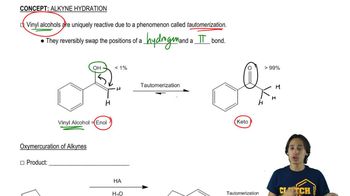
Alkynes

Alkynes are hydrocarbons that contain at least one carbon-carbon triple bond. They are unsaturated compounds and are represented by the general formula CnH2n-2. Alkynes can undergo various reactions, including addition reactions, which are crucial for synthesizing other organic compounds, such as alkenes and alcohols.
Video consigliato:
09:11
Alkyne Hydration

Trans-Alkenes

Trans-alkenes are a type of alkene where the substituents on the double bond are on opposite sides, leading to a more stable configuration due to reduced steric strain. The geometric isomerism in alkenes is significant in determining their physical and chemical properties, making it essential to understand how to synthesize them from alkynes.
Video consigliato:
Percorso guidato
3:04
Alkene Metathesis Example 2

Hydroboration-Oxidation

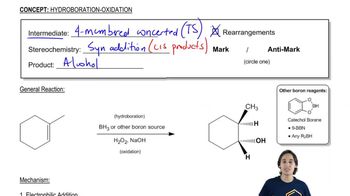
Hydroboration-oxidation is a two-step reaction process used to convert alkynes into alkenes. In the first step, an alkyl borane is formed, which adds across the triple bond, followed by oxidation with hydrogen peroxide to yield the corresponding alcohol. This method is particularly useful for synthesizing trans-alkenes due to its regioselectivity and stereochemistry.
Video consigliato:
06:38
General properties of hydroboration-oxidation.