Ch. 10 - Alkynes: Electrophilic Addition and Redox Reactions
Mullins - Organic Chemistry: A Learner Centered Approach 1st Edition
Mullins1st EditionOrganic Chemistry: A Learner Centered ApproachISBN: 9780137566471Non è quello che usi tu?Cambia libro di testo
Capitolo 9, Problema 13

Which of the following would be expected to give a hotter flame during combustion? Explain.

Guida verificata passo dopo passo
1
Step 1: Understand the combustion process. Combustion is a chemical reaction where a hydrocarbon reacts with oxygen to produce carbon dioxide, water, and energy in the form of heat. The amount of heat released depends on the molecular structure and the degree of unsaturation of the hydrocarbon.
Step 2: Analyze the molecular structures of butane and but-2-yne. Butane is a saturated hydrocarbon (alkane) with the formula C4H10, while but-2-yne is an unsaturated hydrocarbon (alkyne) with the formula C4H6, containing a triple bond between two carbon atoms.
Step 3: Consider the degree of unsaturation. Unsaturated hydrocarbons like but-2-yne have fewer hydrogen atoms compared to their saturated counterparts, which means they have a higher carbon-to-hydrogen ratio. This higher ratio typically results in a hotter flame during combustion because more energy is released per mole of carbon burned.
Step 4: Evaluate the bond energies. Triple bonds in but-2-yne require more energy to break compared to single bonds in butane. This contributes to the higher energy release during combustion of but-2-yne.
Step 5: Conclude that but-2-yne would give a hotter flame during combustion due to its higher carbon-to-hydrogen ratio and the presence of a triple bond, which results in a greater energy release compared to the saturated hydrocarbon butane.

Risposta video verificata per un problema simile:

Questa soluzione video è stata consigliata dai nostri tutor come utile per risolvere questo problema.
Durata del video:
4m

Concetti chiave

Ecco i concetti essenziali che devi comprendere per rispondere correttamente alla domanda.

Combustion Reaction

Combustion is a chemical reaction that occurs when a substance reacts rapidly with oxygen, producing heat and light. In organic chemistry, this typically involves hydrocarbons, which can vary in structure and composition. The efficiency and temperature of the flame produced during combustion depend on the type of fuel and its molecular structure.
Video consigliato:
02:55
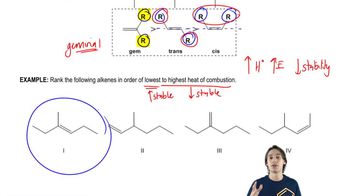
Heat of Combustion

Hydrocarbon Structure

Hydrocarbons are organic compounds consisting solely of hydrogen and carbon atoms. Their structure can be linear, branched, or cyclic, and the presence of functional groups can influence their combustion properties. Generally, more complex hydrocarbons with higher carbon content tend to release more energy during combustion, resulting in a hotter flame.
Video consigliato:
04:52
Aromaticity of Hydrocarbons

Energy Release and Flame Temperature

The temperature of a flame during combustion is directly related to the amount of energy released from the fuel. Fuels that produce more complete combustion, yielding more heat, will generate hotter flames. Factors such as the fuel's molecular weight, bond energies, and the presence of oxygen affect the overall energy output and flame temperature.
Video consigliato:
02:18
Favorability and rate of Free Energy Diagrams