Ch. 11 - Properties and Synthesis of Alkyl Halides: Radical Reactions
Mullins - Organic Chemistry: A Learner Centered Approach 1st Edition
Mullins1st EditionOrganic Chemistry: A Learner Centered ApproachISBN: 9780137566471Non è quello che usi tu?Cambia libro di testo
Capitolo 10, Problema 62d

A halogenation intended to make compound A formed B instead.

(d) Without looking it up, would you expect C–Ha or C–Hb to have the lower bond-dissociation energy?

Guida verificata passo dopo passo
1
Identify the type of reaction: The image shows a halogenation reaction using Br2 and heat, which suggests a radical halogenation process.
Analyze the structure of compound A and B: Compound A has the bromine attached to the secondary carbon (C-Ha), while compound B has the bromine attached to the tertiary carbon (C-Hb).
Consider the stability of radicals: In radical halogenation, the stability of the radical intermediate is crucial. Tertiary radicals are more stable than secondary radicals due to hyperconjugation and inductive effects.
Predict the bond-dissociation energy: The bond-dissociation energy is lower for the bond that forms the more stable radical. Therefore, the C-Hb bond, which forms a tertiary radical, is expected to have a lower bond-dissociation energy compared to the C-Ha bond.
Conclude the reasoning: Since compound B is formed, it indicates that the reaction favors the formation of the more stable tertiary radical, which aligns with the expectation that C-Hb has a lower bond-dissociation energy.

Risposta video verificata per un problema simile:

Questa soluzione video è stata consigliata dai nostri tutor come utile per risolvere questo problema.

Concetti chiave

Ecco i concetti essenziali che devi comprendere per rispondere correttamente alla domanda.

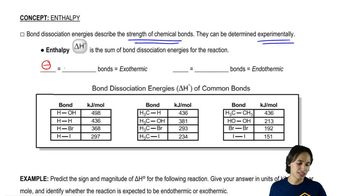
Bond Dissociation Energy

Bond dissociation energy (BDE) is the energy required to break a bond in a molecule, resulting in the separation of atoms. In organic chemistry, BDE is crucial for understanding reaction mechanisms, particularly in radical reactions. Lower BDE indicates a weaker bond, which is more easily broken, influencing the site of halogenation in a molecule.
Video consigliato:
04:09
How to calculate enthalpy using bond dissociation energies.

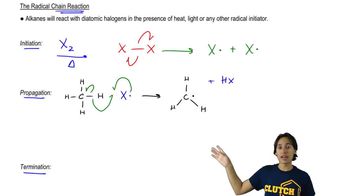
Radical Halogenation

Radical halogenation involves the substitution of a hydrogen atom in a hydrocarbon with a halogen atom, typically through a radical mechanism. This process is influenced by the stability of the resulting radical, with tertiary radicals being more stable than secondary or primary ones. The stability of the radical formed dictates the preferred site of halogenation.
Video consigliato:
12:11
Radical Chain Reaction Mechanism.

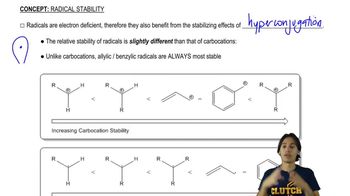
Radical Stability

Radical stability is determined by the ability of a radical to delocalize its unpaired electron, often through hyperconjugation or resonance. Tertiary radicals are more stable than secondary or primary radicals due to greater hyperconjugation and electron-donating effects from surrounding alkyl groups. This stability influences the outcome of radical reactions, such as halogenation.
Video consigliato:
03:43
The radical stability trend.