Ch. 11 - Properties and Synthesis of Alkyl Halides: Radical Reactions
Mullins - Organic Chemistry: A Learner Centered Approach 1st Edition
Mullins1st EditionOrganic Chemistry: A Learner Centered ApproachISBN: 9780137566471Non è quello che usi tu?Cambia libro di testo
Capitolo 10, Problema 42(a)

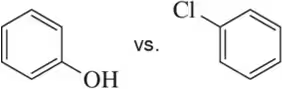
In each pair,
(i) choose the compound that is most soluble in water.
(ii) Within each pair, which is most soluble in nonpolar solvents?
(a) Chemical structures of phenol (OH) and chlorobenzene (Cl) for solubility comparison in water and nonpolar solvents.

Guida verificata passo dopo passo
1
Step 1: Analyze the structures of the two compounds. Compound (I) is benzene-1,2-diol (catechol), which contains two hydroxyl (-OH) groups attached to the benzene ring. Compound (II) is methylbenzene (toluene), which contains a methyl (-CH3) group attached to the benzene ring.
Step 2: Consider the solubility in water. Water is a polar solvent, and compounds with polar functional groups (such as hydroxyl groups) are more soluble in water due to hydrogen bonding. Compound (I) has two hydroxyl groups, which can form hydrogen bonds with water molecules, making it more soluble in water compared to Compound (II), which has a nonpolar methyl group.
Step 3: Consider the solubility in nonpolar solvents. Nonpolar solvents dissolve nonpolar compounds better due to the principle of 'like dissolves like.' Compound (II) has a nonpolar methyl group and a benzene ring, making it more soluble in nonpolar solvents compared to Compound (I), which has polar hydroxyl groups.
Step 4: Summarize the findings. Compound (I) is most soluble in water due to its polar hydroxyl groups, while Compound (II) is most soluble in nonpolar solvents due to its nonpolar methyl group and benzene ring.
Step 5: To further understand, recall that solubility depends on the ability of the solvent to interact with the solute. Polar solvents like water interact strongly with polar groups, while nonpolar solvents interact with nonpolar groups through dispersion forces.

Risposta video verificata per un problema simile:

Questa soluzione video è stata consigliata dai nostri tutor come utile per risolvere questo problema.
Durata del video:
2m

Concetti chiave

Ecco i concetti essenziali che devi comprendere per rispondere correttamente alla domanda.

Polarity and Solubility

Polarity refers to the distribution of electrical charge over the atoms in a molecule. Polar molecules, which have a significant difference in electronegativity between atoms, tend to dissolve well in polar solvents like water. In contrast, nonpolar molecules, which have an even distribution of charge, are more soluble in nonpolar solvents, such as hydrocarbons.
Video consigliato:
07:13
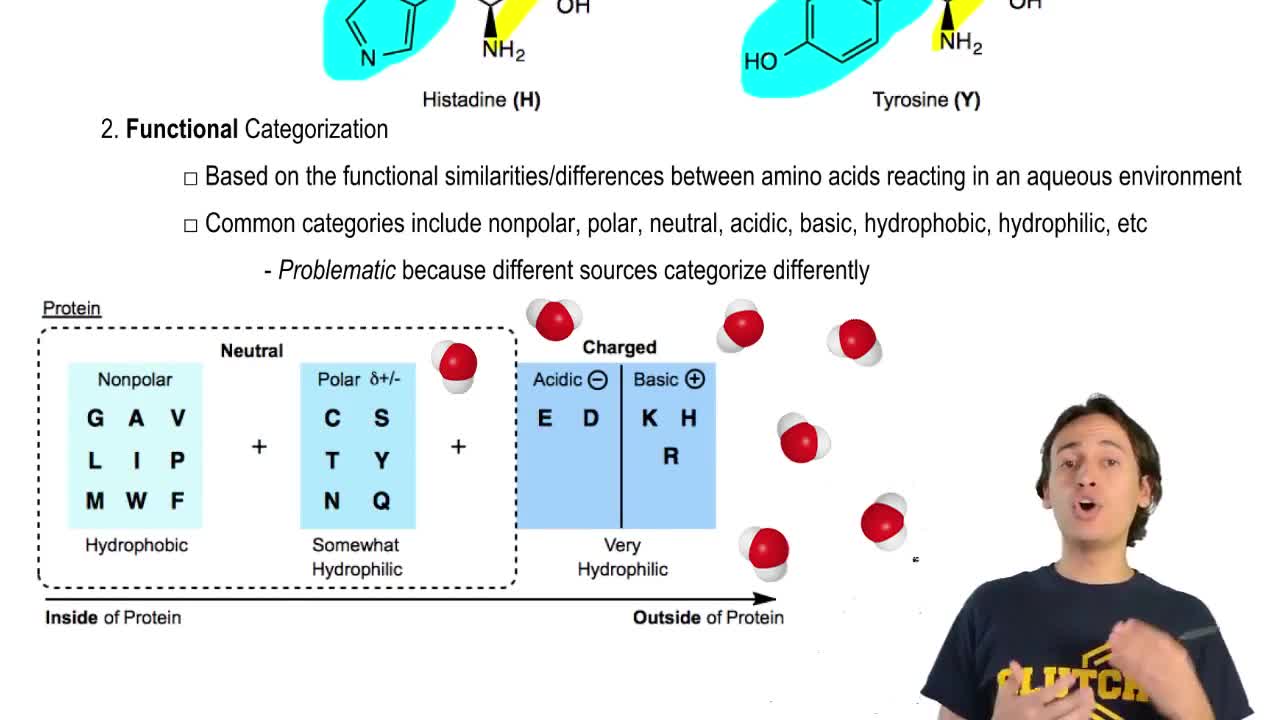
Functional Classification

Hydroxyl Group and Hydrogen Bonding

The hydroxyl group (-OH) is a functional group that significantly increases a compound's polarity due to its ability to form hydrogen bonds with water molecules. This property enhances the solubility of compounds containing hydroxyl groups in polar solvents, making phenol (compound I) more soluble in water compared to toluene (compound II), which lacks such polar functional groups.
Video consigliato:
00:48
The definition of hydrogenation.

Hydrocarbon Structure

Hydrocarbons are organic compounds consisting entirely of hydrogen and carbon. Toluene, which is a hydrocarbon with a methyl group, is nonpolar and thus more soluble in nonpolar solvents. The structure of hydrocarbons, particularly their lack of polar functional groups, dictates their solubility behavior in different solvent environments.
Video consigliato:
04:52
Aromaticity of Hydrocarbons