Ch. 11 - Properties and Synthesis of Alkyl Halides: Radical Reactions
Mullins - Organic Chemistry: A Learner Centered Approach 1st Edition
Mullins1st EditionOrganic Chemistry: A Learner Centered ApproachISBN: 9780137566471Non è quello che usi tu?Cambia libro di testo
Capitolo 10, Problema 41d

Which of the reactions studied in this chapter result in oxidation of the organic molecule? Justify your answer.
(d)

Guida verificata passo dopo passo
1
Identify the type of reaction: The reaction shown involves the addition of bromine (Br2) to an alkane, resulting in the formation of an alkyl bromide.
Understand oxidation in organic chemistry: Oxidation typically involves the increase in the number of bonds to oxygen or other electronegative atoms (like halogens) or the decrease in the number of bonds to hydrogen.
Analyze the change in the molecule: In the given reaction, a hydrogen atom in the alkane is replaced by a bromine atom, which is more electronegative than hydrogen.
Determine if oxidation occurs: Since the replacement of hydrogen with bromine increases the number of bonds to a more electronegative atom, this reaction can be considered an oxidation.
Justify the oxidation: The introduction of a bromine atom increases the oxidation state of the carbon atom to which it is attached, thus classifying the reaction as an oxidation process.

Risposta video verificata per un problema simile:

Questa soluzione video è stata consigliata dai nostri tutor come utile per risolvere questo problema.

Concetti chiave

Ecco i concetti essenziali che devi comprendere per rispondere correttamente alla domanda.

Oxidation in Organic Chemistry

Oxidation refers to the process where an organic molecule loses electrons, often accompanied by an increase in oxidation state. In organic chemistry, this can involve the addition of oxygen or the removal of hydrogen. Understanding the specific reactions that lead to oxidation is crucial for identifying which reactions in the chapter result in this transformation.
Video consigliato:
00:56
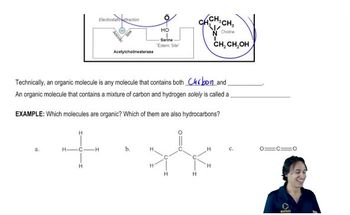
What is an organic molecule?

Common Oxidizing Agents

Oxidizing agents are substances that facilitate the oxidation of organic molecules by accepting electrons. Common examples include potassium permanganate (KMnO4), chromium trioxide (CrO3), and hydrogen peroxide (H2O2). Recognizing these agents helps in determining which reactions lead to oxidation and understanding their mechanisms.
Video consigliato:
03:40
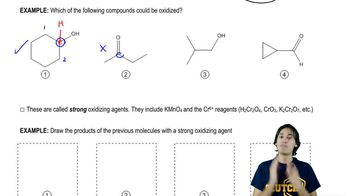
Strong oxidizing agents

Reaction Mechanisms

A reaction mechanism describes the step-by-step process by which reactants are converted into products. In the context of oxidation reactions, mechanisms often involve the formation of intermediates and the transfer of electrons. Analyzing these mechanisms is essential for justifying which reactions result in oxidation and understanding the overall transformation of the organic molecule.
Video consigliato:
02:16
Heck Reaction Mechanism