Ch. 12 - Substitution and Elimination: Reactions of Haloalkanes
Mullins - Organic Chemistry: A Learner Centered Approach 1st Edition
Mullins1st EditionOrganic Chemistry: A Learner Centered ApproachISBN: 9780137566471Non è quello che usi tu?Cambia libro di testo
Capitolo 11, Problema 59c

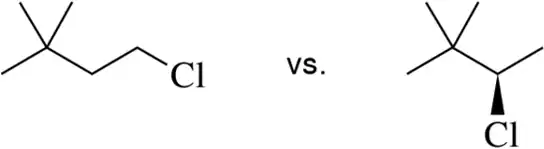
For each pair, choose the haloalkane that would react most quickly in an Sₙ1 or E1 reaction.
(c) Structural comparison of two haloalkanes with chlorine, indicating reactivity in Sₙ1 or E1 reactions.

Guida verificata passo dopo passo
1
Step 1: Understand the mechanism of Sₙ1 and E1 reactions. Both mechanisms proceed through the formation of a carbocation intermediate. The rate of the reaction depends on the stability of the carbocation formed after the leaving group departs.
Step 2: Analyze the structure of each haloalkane in the pair. Identify the carbon atom bonded to the halogen and determine the type of carbocation that would form (primary, secondary, or tertiary) if the halogen leaves.
Step 3: Recall that tertiary carbocations are the most stable due to inductive effects and hyperconjugation, followed by secondary carbocations, and then primary carbocations. Allylic and benzylic carbocations are also highly stabilized due to resonance effects.
Step 4: Consider the leaving group. A good leaving group (e.g., Br⁻, I⁻) facilitates the formation of the carbocation. Compare the leaving groups in the haloalkanes to ensure they are similar or determine which one is better.
Step 5: Choose the haloalkane that forms the most stable carbocation upon the departure of the leaving group. This haloalkane will react most quickly in an Sₙ1 or E1 reaction.

Risposta video verificata per un problema simile:

Questa soluzione video è stata consigliata dai nostri tutor come utile per risolvere questo problema.
Durata del video:
3m

Concetti chiave

Ecco i concetti essenziali che devi comprendere per rispondere correttamente alla domanda.

Sₙ1 and E1 Mechanisms

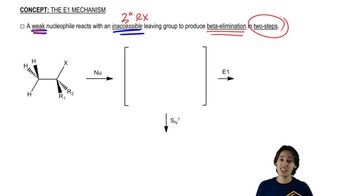
Sₙ1 (nucleophilic substitution unimolecular) and E1 (elimination unimolecular) are reaction mechanisms that involve the formation of a carbocation intermediate. In Sₙ1 reactions, a nucleophile attacks the carbocation, while in E1 reactions, a base abstracts a proton, leading to the formation of a double bond. Both mechanisms are favored by tertiary haloalkanes due to their ability to stabilize the carbocation.
Video consigliato:
08:09
Drawing the E1 Mechanism.

Carbocation Stability

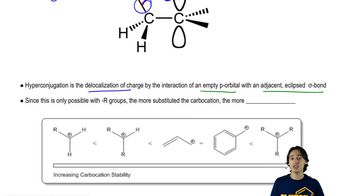
The stability of carbocations is crucial in determining the rate of Sₙ1 and E1 reactions. Tertiary carbocations are more stable than secondary or primary ones due to hyperconjugation and inductive effects from surrounding alkyl groups. The more stable the carbocation, the faster the reaction will proceed, making tertiary haloalkanes more reactive in these mechanisms.
Video consigliato:
05:58
Determining Carbocation Stability

Leaving Group Ability

The ability of a leaving group to depart from the substrate is a key factor in Sₙ1 and E1 reactions. Good leaving groups, such as iodide or bromide, can stabilize the transition state and facilitate the formation of the carbocation. The better the leaving group, the faster the reaction will occur, as it can more readily dissociate from the haloalkane.
Video consigliato:
03:06
How to use the factors affecting acidity to predict leaving group ability.