Ch. 12 - Substitution and Elimination: Reactions of Haloalkanes
Mullins - Organic Chemistry: A Learner Centered Approach 1st Edition
Mullins1st EditionOrganic Chemistry: A Learner Centered ApproachISBN: 9780137566471Non è quello che usi tu?Cambia libro di testo
Capitolo 11, Problema 22c

Which nucleophile would be more reactive in the solvent given
(c)

Guida verificata passo dopo passo
1
Step 1: Identify the solvent given in the problem. The solvent shown in the image is tetrahydrofuran (THF), which is an aprotic solvent. Aprotic solvents do not donate hydrogen bonds and do not stabilize nucleophiles through hydrogen bonding.
Step 2: Understand the behavior of nucleophiles in aprotic solvents. In aprotic solvents, nucleophilicity is primarily determined by the basicity of the nucleophile rather than its size or polarizability. Smaller, more basic nucleophiles tend to be more reactive in aprotic solvents.
Step 3: Compare the nucleophiles provided (F⁻ and I⁻). Fluoride (F⁻) is a smaller ion and has a higher charge density compared to iodide (I⁻). This makes F⁻ a stronger base than I⁻.
Step 4: Analyze the effect of the solvent on the nucleophiles. Since THF is an aprotic solvent, it does not stabilize larger, polarizable ions like I⁻ as much as protic solvents would. Therefore, the smaller and more basic nucleophile (F⁻) will be more reactive in this solvent.
Step 5: Conclude that in the given solvent (THF), F⁻ would be the more reactive nucleophile compared to I⁻ due to its higher basicity and smaller size, which are favored in aprotic solvents.

Risposta video verificata per un problema simile:

Questa soluzione video è stata consigliata dai nostri tutor come utile per risolvere questo problema.

Concetti chiave

Ecco i concetti essenziali che devi comprendere per rispondere correttamente alla domanda.

Nucleophilicity

Nucleophilicity refers to the ability of a nucleophile to donate an electron pair to an electrophile during a chemical reaction. Factors influencing nucleophilicity include charge, electronegativity, and steric hindrance. Generally, negatively charged species are more nucleophilic than neutral ones, and less sterically hindered nucleophiles are more reactive.
Video consigliato:
08:27
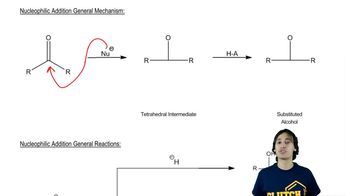
Nucleophilic Addition

Solvent Effects

The solvent can significantly affect the reactivity of nucleophiles. Polar protic solvents can stabilize nucleophiles through hydrogen bonding, often reducing their reactivity, while polar aprotic solvents can enhance nucleophilicity by not stabilizing the nucleophile as much. Understanding the solvent's nature is crucial for predicting the outcome of nucleophilic reactions.
Video consigliato:
01:16
Identification of polarity in solvents

Comparative Reactivity

When comparing the reactivity of two nucleophiles, it is essential to consider their structural features and the solvent environment. Factors such as the presence of electron-donating or withdrawing groups, as well as the overall steric and electronic properties, can determine which nucleophile will be more reactive in a given reaction context.
Video consigliato:
01:17
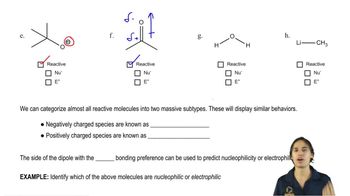
Reactivity of Molecules