Ch. 13 - Alcohols, Ethers and Related Compounds: Substitution and Elimination
Mullins - Organic Chemistry: A Learner Centered Approach 1st Edition
Mullins1st EditionOrganic Chemistry: A Learner Centered ApproachISBN: 9780137566471Non è quello che usi tu?Cambia libro di testo
Capitolo 12, Problema 93

(a) Show how you would affect the following transformation using a tosylate.
(b) Why might this not be the most sustainable method?
(c) What reagent might you use instead?

Guida verificata passo dopo passo
1
Step 1: Identify the functional group transformation. The problem involves converting an alcohol group (-OH) to a bromide group (-Br).
Step 2: Use a tosylate to facilitate the transformation. Convert the alcohol to a tosylate by reacting it with p-toluenesulfonyl chloride (TsCl) in the presence of a base like pyridine. This will form the tosylate ester, which is a good leaving group.
Step 3: Perform the nucleophilic substitution. Treat the tosylate with a bromide ion source, such as sodium bromide (NaBr), to replace the tosylate group with a bromide ion, resulting in the desired alkyl bromide.
Step 4: Consider sustainability. The use of tosylates involves the generation of waste products and may require toxic reagents, which can be less sustainable.
Step 5: Suggest an alternative reagent. Instead of using tosylates, you might use phosphorus tribromide (PBr3) directly on the alcohol to convert it to the bromide, which can be a more sustainable and direct method.

Risposta video verificata per un problema simile:

Questa soluzione video è stata consigliata dai nostri tutor come utile per risolvere questo problema.

Concetti chiave

Ecco i concetti essenziali che devi comprendere per rispondere correttamente alla domanda.

Tosylate Formation

Tosylates are derived from tosyl chloride and are used to convert alcohols into better leaving groups. This transformation enhances the reactivity of alcohols in nucleophilic substitution reactions. The tosylate group is a sulfonate ester, which stabilizes the leaving group during the reaction, facilitating the conversion to other functional groups.
Video consigliato:
02:26
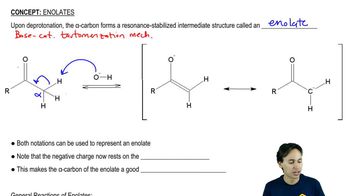
Formation of Enolates

Sustainability in Organic Chemistry

Sustainability in organic chemistry refers to the environmental impact and resource efficiency of chemical processes. Methods that produce hazardous waste, require toxic reagents, or consume excessive energy are often deemed unsustainable. Evaluating the sustainability of a reaction involves considering alternative methods that minimize waste and use safer, renewable resources.
Video consigliato:
00:56
What is an organic molecule?

Alternative Reagents

Alternative reagents are substances that can replace traditional reagents in chemical reactions to improve efficiency or reduce environmental impact. For example, using greener solvents or catalysts can lead to more sustainable reactions. In the context of the question, identifying a reagent that can achieve the desired transformation without the drawbacks of tosylates is crucial for developing a more sustainable approach.
Video consigliato:
01:52
Reagents