Ch. 13 - Alcohols, Ethers and Related Compounds: Substitution and Elimination
Mullins - Organic Chemistry: A Learner Centered Approach 1st Edition
Mullins1st EditionOrganic Chemistry: A Learner Centered ApproachISBN: 9780137566471Non è quello che usi tu?Cambia libro di testo
Capitolo 12, Problema 26b

Complete the following multistep syntheses using tosylate formation as one of the steps. The optimum number of steps for each synthesis is shown.
(b) Cyclopentanol to cyclopentene conversion in two steps, illustrating tosylate formation as an intermediate step.

Guida verificata passo dopo passo
1
Identify the starting material and the target molecule for the synthesis. This will help in planning the steps required to transform the starting material into the desired product.
Determine the functional groups present in the starting material and the target molecule. This will guide you in selecting the appropriate reactions to introduce or modify functional groups.
Plan the synthesis by identifying the key transformations needed. Since tosylate formation is specified, consider where in the synthesis this step will be most effective. Tosylates are often used to convert alcohols into good leaving groups for nucleophilic substitution reactions.
For the tosylate formation step, convert an alcohol group in the starting material to a tosylate. This involves reacting the alcohol with p-toluenesulfonyl chloride (TsCl) in the presence of a base, such as pyridine, to form the tosylate ester.
After forming the tosylate, proceed with the subsequent steps to achieve the target molecule. This may involve nucleophilic substitution reactions, elimination reactions, or other transformations, depending on the functional groups present and the structure of the target molecule.

Risposta video verificata per un problema simile:

Questa soluzione video è stata consigliata dai nostri tutor come utile per risolvere questo problema.
Durata del video:
5m

Concetti chiave

Ecco i concetti essenziali che devi comprendere per rispondere correttamente alla domanda.

Tosylate Formation

Tosylate formation involves converting an alcohol into a tosylate ester using tosyl chloride (TsCl) in the presence of a base like pyridine. This transformation makes the hydroxyl group a better leaving group, facilitating subsequent nucleophilic substitution reactions. Tosylates are useful intermediates in organic synthesis due to their enhanced reactivity compared to alcohols.
Video consigliato:
02:26
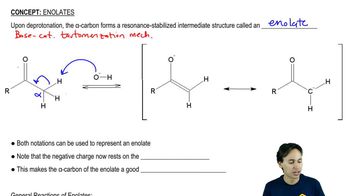
Formation of Enolates

Nucleophilic Substitution

Nucleophilic substitution is a fundamental reaction in organic chemistry where a nucleophile replaces a leaving group in a molecule. In the context of tosylate formation, the tosylate group acts as a superior leaving group, allowing for efficient substitution by various nucleophiles. Understanding the mechanism, whether SN1 or SN2, is crucial for predicting the outcome of the reaction.
Video consigliato:
01:47
Nucleophiles and Electrophiles can react in Substitution Reactions.

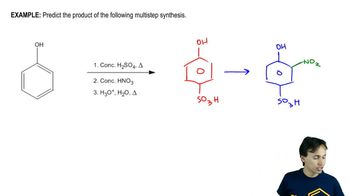
Multistep Synthesis Strategy

Multistep synthesis involves planning and executing a series of chemical reactions to transform starting materials into a desired product. It requires understanding the reactivity and compatibility of functional groups, as well as the order of steps to maximize yield and efficiency. Each step must be carefully chosen to ensure the overall synthesis proceeds smoothly, often using intermediates like tosylates to facilitate transformations.
Video consigliato:
02:15
Multistep Synthesis