Ch. 13 - Alcohols, Ethers and Related Compounds: Substitution and Elimination
Mullins - Organic Chemistry: A Learner Centered Approach 1st Edition
Mullins1st EditionOrganic Chemistry: A Learner Centered ApproachISBN: 9780137566471Non è quello che usi tu?Cambia libro di testo
Capitolo 12, Problema 27

On the reaction coordinate diagram for the disfavored nucleophilic displacement of hydroxide, predict the curve that would demonstrate how using a tosylate makes the substitution favorable.
<IMAGE>

Guida verificata passo dopo passo
1
Begin by understanding the reaction coordinate diagram, which plots the energy changes during a chemical reaction. The x-axis represents the progress of the reaction, while the y-axis represents the energy level.
Identify the initial state of the reactants and the final state of the products on the diagram. For a disfavored nucleophilic displacement of hydroxide, the energy of the transition state is typically high, making the reaction less favorable.
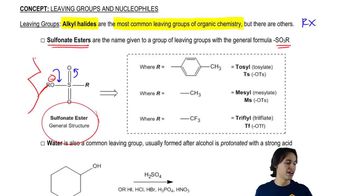
Introduce the concept of a tosylate group. Tosylates are excellent leaving groups due to their ability to stabilize the negative charge, thus lowering the energy of the transition state.
Predict how the curve would change with the use of a tosylate. The energy barrier (activation energy) should decrease, making the transition state lower in energy compared to the original reaction with hydroxide.
Visualize the new curve on the diagram. The curve should show a lower peak for the transition state, indicating a more favorable reaction pathway with the tosylate as the leaving group.

Risposta video verificata per un problema simile:

Questa soluzione video è stata consigliata dai nostri tutor come utile per risolvere questo problema.

Concetti chiave

Ecco i concetti essenziali che devi comprendere per rispondere correttamente alla domanda.

Reaction Coordinate Diagram

A reaction coordinate diagram is a graphical representation of the energy changes that occur during a chemical reaction. It plots the potential energy of the system as the reaction progresses from reactants to products. Key features include the energy of activation, transition states, and the overall energy change, which help in understanding the reaction's kinetics and thermodynamics.
Video consigliato:
05:02
Coordination Complexes

Nucleophilic Substitution

Nucleophilic substitution is a fundamental type of reaction in organic chemistry where a nucleophile replaces a leaving group in a molecule. The reaction can proceed via two main mechanisms: SN1, which involves a two-step process with a carbocation intermediate, and SN2, which is a one-step bimolecular process. The nature of the nucleophile, leaving group, and substrate significantly influences the reaction pathway and rate.
Video consigliato:
01:47
Nucleophiles and Electrophiles can react in Substitution Reactions.

Tosylate as a Leaving Group

Tosylate (p-toluenesulfonate) is a superior leaving group compared to hydroxide due to its ability to stabilize the negative charge through resonance and its large size, which disperses charge. In nucleophilic substitution reactions, replacing a poor leaving group like hydroxide with tosylate can make the reaction more favorable by lowering the activation energy, thus enhancing the reaction rate and yield.
Video consigliato:
07:22
The 3 important leaving groups to know.