Ch. 13 - Alcohols, Ethers and Related Compounds: Substitution and Elimination
Mullins - Organic Chemistry: A Learner Centered Approach 1st Edition
Mullins1st EditionOrganic Chemistry: A Learner Centered ApproachISBN: 9780137566471Non è quello che usi tu?Cambia libro di testo
Capitolo 12, Problema 101c

Draw a mechanism for the following oxidation reactions.
(c)

Guida verificata passo dopo passo
1
Identify the starting material and the product: The starting material is a secondary alcohol, and the product is a ketone. This indicates an oxidation reaction where the alcohol is converted to a carbonyl group.
Recognize the reagent: The reagent is thionyl chloride (SOCl2), which is commonly used to convert alcohols to alkyl chlorides. However, in this context, it is used to facilitate the oxidation of the alcohol to a ketone.
Understand the mechanism: The reaction likely involves the formation of an intermediate chlorosulfite ester. The alcohol oxygen attacks the sulfur atom of thionyl chloride, leading to the formation of this intermediate.
Formation of the chlorosulfite ester: The hydroxyl group of the alcohol attacks the sulfur atom in thionyl chloride, displacing a chloride ion and forming a chlorosulfite ester intermediate.
Elimination to form the ketone: The chlorosulfite ester undergoes elimination, where the chloride ion acts as a leaving group, resulting in the formation of a carbonyl group (ketone) and the release of sulfur dioxide (SO2) and hydrochloric acid (HCl) as byproducts.

Risposta video verificata per un problema simile:

Questa soluzione video è stata consigliata dai nostri tutor come utile per risolvere questo problema.
Durata del video:
5m

Concetti chiave

Ecco i concetti essenziali che devi comprendere per rispondere correttamente alla domanda.

Oxidation Reactions

Oxidation reactions involve the loss of electrons or an increase in oxidation state by a molecule, atom, or ion. In organic chemistry, this often pertains to the conversion of alcohols to carbonyl compounds (aldehydes or ketones) or carboxylic acids. Understanding the specific reagents and conditions that facilitate these transformations is crucial for drawing accurate reaction mechanisms.
Video consigliato:
03:20
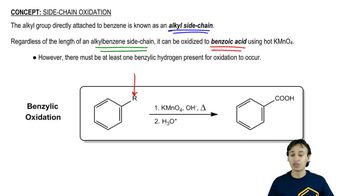
Benzylic Oxidation

Reaction Mechanisms

A reaction mechanism is a step-by-step description of how a chemical reaction occurs at the molecular level. It outlines the sequence of bond-breaking and bond-forming events, including intermediates and transition states. For oxidation reactions, mechanisms often involve the formation of reactive intermediates, such as radicals or carbocations, which are essential for understanding the overall process.
Video consigliato:
02:16
Heck Reaction Mechanism

Functional Group Transformations

Functional group transformations refer to the chemical changes that occur to specific groups within organic molecules during reactions. In the context of oxidation, this typically involves the conversion of alcohols (–OH) to carbonyls (C=O) or carboxylic acids (–COOH). Recognizing these transformations is vital for predicting the products of oxidation reactions and for accurately illustrating their mechanisms.
Video consigliato:
02:36
Identifying Functional Groups