Ch. 13 - Alcohols, Ethers and Related Compounds: Substitution and Elimination
Mullins - Organic Chemistry: A Learner Centered Approach 1st Edition
Mullins1st EditionOrganic Chemistry: A Learner Centered ApproachISBN: 9780137566471Non è quello che usi tu?Cambia libro di testo
Capitolo 12, Problema 57d

Fill in the missing reactant, reagent, or product for each of the following oxidation reactions. react similarly to chromic acid
(d) Cyclopentanol reacts with KMnO4 and H2O, prompting users to fill in the missing oxidation product.

Guida verificata passo dopo passo
1
Step 1: Understand the role of chromic acid (H₂CrO₄) in oxidation reactions. Chromic acid is a strong oxidizing agent commonly used to oxidize primary alcohols to carboxylic acids and secondary alcohols to ketones.
Step 2: Identify the type of alcohol involved in the reaction. Determine whether the missing component is a primary or secondary alcohol, as this will influence the product formed.
Step 3: Consider alternative oxidizing agents that react similarly to chromic acid. Common alternatives include potassium permanganate (KMnO₄) and sodium dichromate (Na₂Cr₂O₇), which can also oxidize alcohols.
Step 4: If the missing component is a reagent, select an appropriate oxidizing agent based on the type of alcohol and desired product. For example, KMnO₄ can be used in acidic or basic conditions to achieve similar oxidation results.
Step 5: If the missing component is a product, predict the outcome based on the type of alcohol and the oxidizing agent used. For primary alcohols, expect carboxylic acids; for secondary alcohols, expect ketones.

Risposta video verificata per un problema simile:

Questa soluzione video è stata consigliata dai nostri tutor come utile per risolvere questo problema.
Durata del video:
1m

Concetti chiave

Ecco i concetti essenziali che devi comprendere per rispondere correttamente alla domanda.

Oxidation Reactions

Oxidation reactions in organic chemistry involve the increase in oxidation state of a molecule, typically by adding oxygen or removing hydrogen. These reactions are crucial for transforming alcohols into carbonyl compounds, such as aldehydes and ketones, using oxidizing agents like chromic acid.
Video consigliato:
03:20
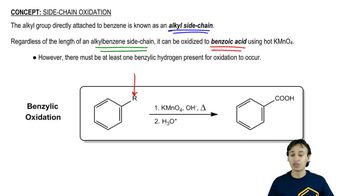
Benzylic Oxidation

Chromic Acid

Chromic acid is a powerful oxidizing agent commonly used in organic chemistry to oxidize primary and secondary alcohols to aldehydes and ketones, respectively. It is often generated in situ from sodium dichromate and sulfuric acid, and its reactivity is similar to other strong oxidizers like PCC and PDC.
Video consigliato:
02:23
Using factors affecting acidity to rank acids

Alcohol Oxidation

Alcohol oxidation is a fundamental reaction in organic chemistry where alcohols are converted into carbonyl compounds. Primary alcohols are oxidized to aldehydes and can further oxidize to carboxylic acids, while secondary alcohols are oxidized to ketones. The choice of oxidizing agent, such as chromic acid, determines the extent of oxidation.
Video consigliato:
05:53
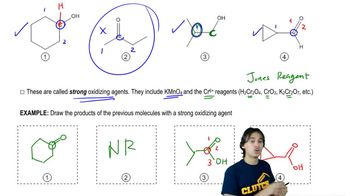
Strong oxidizing agents