Ch. 13 - Alcohols, Ethers and Related Compounds: Substitution and Elimination
Mullins - Organic Chemistry: A Learner Centered Approach 1st Edition
Mullins1st EditionOrganic Chemistry: A Learner Centered ApproachISBN: 9780137566471Non è quello che usi tu?Cambia libro di testo
Capitolo 12, Problema 41a

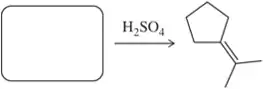
Identify the alcohol(s) that would produce the following alkenes under the given conditions.
(a) Chemical reaction diagram showing dehydration with H₂SO₄, leading to an alkene product from an unspecified alcohol.

Guida verificata passo dopo passo
1
Step 1: Understand the reaction mechanism. The conversion of alcohols to alkenes typically occurs through an elimination reaction, such as E1 or E2, depending on the conditions. In acidic conditions, the reaction often proceeds via the E1 mechanism, involving protonation of the alcohol and formation of a carbocation intermediate.
Step 2: Analyze the structure of the given alkene. Identify the position of the double bond and the carbon atoms involved. This will help determine the possible alcohol precursors.
Step 3: Consider the regioselectivity and stereoselectivity of the elimination reaction. For example, Zaitsev's rule states that the most substituted alkene is usually favored in elimination reactions. This can help predict which alcohols are likely to produce the given alkene.
Step 4: Identify the alcohol(s) that could lead to the given alkene. For each alcohol, consider the position of the hydroxyl group (-OH) and how elimination would occur to form the double bond. Ensure that the elimination follows the correct mechanism (E1 or E2) under the given conditions.
Step 5: Verify the feasibility of the reaction. Check for factors such as carbocation stability (in E1 reactions) or the presence of a strong base (in E2 reactions) to confirm that the identified alcohol(s) can indeed produce the given alkene.

Risposta video verificata per un problema simile:

Questa soluzione video è stata consigliata dai nostri tutor come utile per risolvere questo problema.
Durata del video:
3m

Concetti chiave

Ecco i concetti essenziali che devi comprendere per rispondere correttamente alla domanda.

Alcohol Dehydration

Alcohol dehydration is a chemical reaction where an alcohol loses a water molecule to form an alkene. This process typically occurs under acidic conditions, where the hydroxyl group of the alcohol is protonated, making it a better leaving group. The resulting carbocation can then undergo elimination of a proton, leading to the formation of a double bond in the alkene.
Video consigliato:
01:23
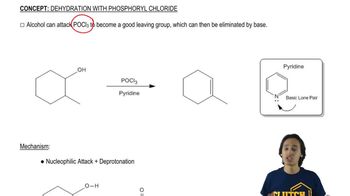
General Reaction of Dehydration with POCl3

Zaitsev's Rule

Zaitsev's Rule states that in elimination reactions, the more substituted alkene is generally the major product. This is because more substituted alkenes are more stable due to hyperconjugation and the inductive effect. Understanding this rule helps predict which alkene will be favored when multiple elimination products are possible from a given alcohol.
Video consigliato:
01:18
Defining Zaitsev’s Rule

Regioselectivity

Regioselectivity refers to the preference of a chemical reaction to yield one structural isomer over others when multiple products are possible. In the context of alcohol dehydration, regioselectivity is influenced by the stability of the carbocation intermediate and the position of the double bond in the resulting alkene. Recognizing regioselectivity is crucial for determining the correct alcohol that will produce the desired alkene.
Video consigliato:
05:09
Heck Reaction