Ch. 13 - Alcohols, Ethers and Related Compounds: Substitution and Elimination
Mullins - Organic Chemistry: A Learner Centered Approach 1st Edition
Mullins1st EditionOrganic Chemistry: A Learner Centered ApproachISBN: 9780137566471Non è quello che usi tu?Cambia libro di testo
Capitolo 12, Problema 40a

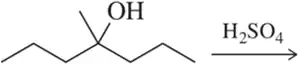
Predict the major product of the following elimination reactions.
(a) Chemical structure showing an alcohol group (OH) and sulfuric acid (H2SO4) indicating a dehydration reaction.

Guida verificata passo dopo passo
1
Identify the type of elimination reaction (E1 or E2) based on the reaction conditions. For example, if a strong base is present, it is likely an E2 reaction, whereas a weak base and a polar protic solvent suggest an E1 reaction.
Determine the structure of the starting material and locate the β-hydrogens (hydrogens on the carbon adjacent to the carbon bearing the leaving group). These β-hydrogens are necessary for the elimination process.
For an E2 reaction, consider the anti-periplanar geometry requirement. The β-hydrogen and the leaving group must be in opposite planes (180° apart) for the elimination to occur. Draw the Newman projection if needed to confirm this geometry.
For an E1 reaction, the first step is the formation of a carbocation intermediate after the leaving group departs. Assess the stability of the carbocation and consider any possible rearrangements (e.g., hydride or alkyl shifts) to form a more stable carbocation.
Apply Zaitsev's rule to predict the major product. Zaitsev's rule states that the more substituted alkene (the one with more alkyl groups attached to the double-bonded carbons) is usually the major product. Draw the possible alkene products and identify the most substituted one as the major product.

Risposta video verificata per un problema simile:

Questa soluzione video è stata consigliata dai nostri tutor come utile per risolvere questo problema.
Durata del video:
7m

Concetti chiave

Ecco i concetti essenziali che devi comprendere per rispondere correttamente alla domanda.

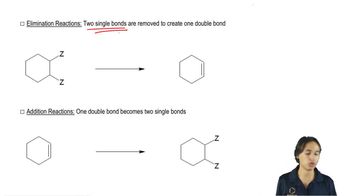
Elimination Reactions

Elimination reactions are a type of organic reaction where two substituents are removed from a molecule, resulting in the formation of a double bond or a ring structure. These reactions typically involve the loss of a leaving group and a hydrogen atom from adjacent carbon atoms. Understanding the mechanism of elimination reactions, such as E1 and E2 pathways, is crucial for predicting the major products formed.
Video consigliato:
00:40
Recognizing Elimination Reactions.

Zaitsev's Rule

Zaitsev's Rule states that in elimination reactions, the more substituted alkene is generally the major product. This is because more substituted alkenes are more stable due to hyperconjugation and the inductive effect. Recognizing this rule helps in predicting the outcome of elimination reactions, especially when multiple alkene products are possible.
Video consigliato:
01:18
Defining Zaitsev’s Rule

Regioselectivity

Regioselectivity refers to the preference of a chemical reaction to yield one structural isomer over others when multiple products are possible. In elimination reactions, regioselectivity is influenced by factors such as sterics and the stability of the resulting double bond. Understanding regioselectivity is essential for accurately predicting the major product in elimination reactions.
Video consigliato:
05:09
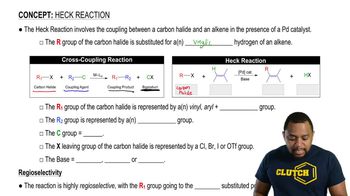
Heck Reaction