Ch. 13 - Alcohols, Ethers and Related Compounds: Substitution and Elimination
Mullins - Organic Chemistry: A Learner Centered Approach 1st Edition
Mullins1st EditionOrganic Chemistry: A Learner Centered ApproachISBN: 9780137566471Non è quello che usi tu?Cambia libro di testo
Capitolo 12, Problema 44a

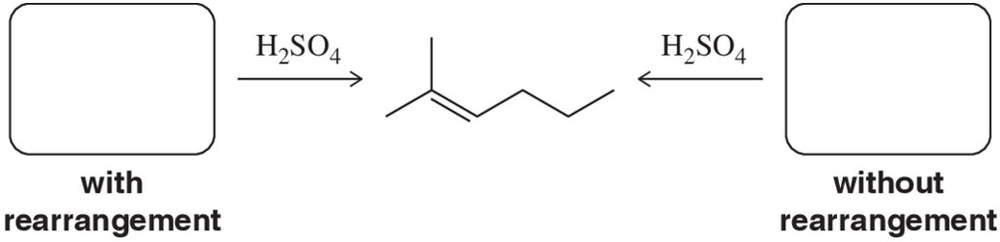
Identify two different alcohols that can be dehydrated (one with rearrangement) to form the alkene shown.
Diagram illustrating dehydration reactions of alcohols to form an alkene, highlighting rearrangement options.

Guida verificata passo dopo passo
1
Analyze the given alkene structure to determine its connectivity and identify possible positions for double bonds. This will help in deducing the alcohol precursors.
Recall that alcohol dehydration involves the loss of a water molecule, typically under acidic conditions, to form an alkene. The reaction follows either the E1 or E2 mechanism depending on the conditions.
For the first alcohol (without rearrangement), identify an alcohol structure where the hydroxyl group is directly attached to a carbon adjacent to the double bond in the alkene. This ensures direct elimination without rearrangement.
For the second alcohol (with rearrangement), consider a scenario where the initial carbocation formed during dehydration undergoes a hydride or alkyl shift to form a more stable carbocation. This rearranged carbocation then leads to the formation of the alkene.
Verify both alcohol structures by mentally performing the dehydration reaction and ensuring that the resulting alkene matches the given structure. Double-check for any stereochemical or regioselectivity considerations.

Risposta video verificata per un problema simile:

Questa soluzione video è stata consigliata dai nostri tutor come utile per risolvere questo problema.
Durata del video:
4m

Concetti chiave

Ecco i concetti essenziali che devi comprendere per rispondere correttamente alla domanda.

Dehydration of Alcohols

Dehydration of alcohols is a chemical reaction where an alcohol loses a water molecule, typically resulting in the formation of an alkene. This process can occur through either an acid-catalyzed mechanism or via elimination reactions. Understanding the conditions and mechanisms of dehydration is crucial for predicting the products formed, especially when considering the stability of the resulting alkenes.
Video consigliato:
01:23
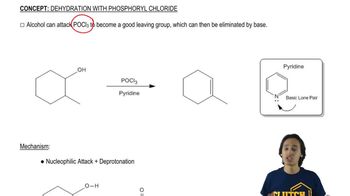
General Reaction of Dehydration with POCl3

Carbocation Rearrangement

Carbocation rearrangement is a process where a carbocation (a positively charged carbon species) shifts to a more stable position during a reaction. This can involve hydride shifts or alkyl shifts, leading to the formation of more stable carbocations. Recognizing when and how rearrangements occur is essential for predicting the major products in dehydration reactions, particularly when multiple pathways are possible.
Video consigliato:
00:47
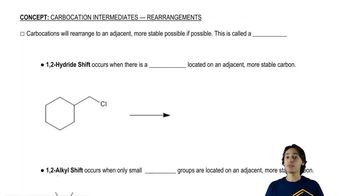
Understanding why carbocations shift.

Alkene Stability and Zaitsev's Rule

Alkene stability is influenced by the degree of substitution on the double bond, with more substituted alkenes being more stable. Zaitsev's Rule states that during elimination reactions, the more substituted alkene is typically the major product. This principle helps in determining which alcohols to choose for dehydration, as it guides the prediction of the most stable alkene that can be formed from the starting materials.
Video consigliato:
01:18
Defining Zaitsev’s Rule