Ch. 13 - Alcohols, Ethers and Related Compounds: Substitution and Elimination
Mullins - Organic Chemistry: A Learner Centered Approach 1st Edition
Mullins1st EditionOrganic Chemistry: A Learner Centered ApproachISBN: 9780137566471Non è quello che usi tu?Cambia libro di testo
Capitolo 12, Problema 71

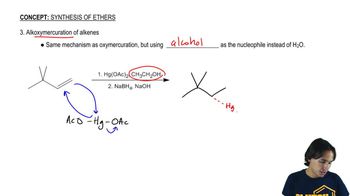
Predict the product and show an arrow-pushing mechanism for the first step of the alkoxymercuration reaction.
Cyclohexene reacts with isopropanol in the presence of mercuric acetate, showing the first step of alkoxymercuration.

Guida verificata passo dopo passo
1
Understand the alkoxymercuration reaction: This reaction involves the addition of an alcohol to an alkene in the presence of mercuric acetate, leading to the formation of an ether. The reaction proceeds through a Markovnikov addition, where the alcohol adds to the more substituted carbon of the alkene.
Identify the reactants: Typically, the reactants include an alkene, an alcohol, and mercuric acetate (Hg(OAc)₂). The alkene is the substrate that will undergo the addition reaction.
Initiate the reaction mechanism: The first step involves the formation of a mercurinium ion intermediate. The alkene reacts with mercuric acetate, where the π electrons of the alkene attack the mercury atom, forming a cyclic mercurinium ion. This is a key step in the mechanism.
Show the arrow-pushing for the mercurinium ion formation: Use curved arrows to indicate the movement of electrons. The π electrons from the alkene will attack the mercury atom, and simultaneously, one of the acetate groups will leave, forming the cyclic mercurinium ion.
Prepare for the next step: Once the mercurinium ion is formed, the alcohol will attack the more substituted carbon of the mercurinium ion, leading to the opening of the ring and formation of the ether product. This step involves nucleophilic attack and is crucial for the completion of the alkoxymercuration reaction.

Risposta video verificata per un problema simile:

Questa soluzione video è stata consigliata dai nostri tutor come utile per risolvere questo problema.
Durata del video:
9m

Concetti chiave

Ecco i concetti essenziali che devi comprendere per rispondere correttamente alla domanda.

Alkoxymercuration Reaction

Alkoxymercuration is a chemical reaction that involves the addition of an alcohol across an alkene using mercuric acetate in the presence of an alcohol solvent. This reaction is used to form ethers and proceeds through a three-step mechanism: formation of a mercurinium ion, nucleophilic attack by the alcohol, and demercuration. Understanding this reaction is crucial for predicting the product and mechanism.
Video consigliato:
04:21
The Mechanism of Alkoxymercuation.

Mercurinium Ion Formation

The first step in the alkoxymercuration reaction is the formation of a mercurinium ion. This occurs when the alkene reacts with mercuric acetate, leading to the formation of a three-membered ring intermediate. The mercurinium ion is a key intermediate that stabilizes the positive charge and directs the subsequent nucleophilic attack by the alcohol.
Video consigliato:
Percorso guidato
3:39
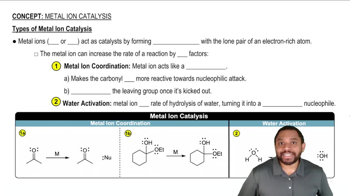
Metal Ion Catalysis Concept 1

Arrow-Pushing Mechanism

Arrow-pushing is a technique used to illustrate the movement of electrons during a chemical reaction. In the context of alkoxymercuration, it involves showing how the electrons from the alkene pi bond interact with the mercury ion to form the mercurinium ion, and how the alcohol attacks this intermediate. Mastery of arrow-pushing is essential for visualizing and understanding the step-by-step process of the reaction.
Video consigliato:
04:32
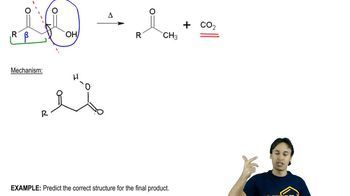
General Mechanism