Ch. 13 - Alcohols, Ethers and Related Compounds: Substitution and Elimination
Mullins - Organic Chemistry: A Learner Centered Approach 1st Edition
Mullins1st EditionOrganic Chemistry: A Learner Centered ApproachISBN: 9780137566471Non è quello che usi tu?Cambia libro di testo
Capitolo 12, Problema 68

Why is the SN1 reaction shown an inefficient way of synthesizing ethers?

Guida verificata passo dopo passo
1
The SN1 reaction mechanism involves the formation of a carbocation intermediate. In the given reaction, the leaving group is chloride (Cl-) from the cyclohexyl chloride, which forms a cyclohexyl carbocation.
Carbocations are prone to rearrangements, especially if a more stable carbocation can be formed. In this case, the cyclohexyl carbocation is relatively stable, but rearrangements can still occur, leading to side products.
The nucleophile in this reaction is isopropanol (CH3CHOHCH3). In SN1 reactions, the nucleophile attacks the carbocation, forming the ether product. However, the reaction can be inefficient due to competing reactions such as elimination, which can occur under similar conditions.
The SN1 mechanism is generally not preferred for synthesizing ethers because it often leads to a mixture of products due to the possibility of rearrangements and side reactions. This reduces the yield and purity of the desired ether product.
Alternative methods, such as the Williamson ether synthesis, are typically more efficient for synthesizing ethers. This method involves an SN2 reaction, which avoids carbocation intermediates and provides better control over the reaction outcome.

Risposta video verificata per un problema simile:

Questa soluzione video è stata consigliata dai nostri tutor come utile per risolvere questo problema.

Concetti chiave

Ecco i concetti essenziali che devi comprendere per rispondere correttamente alla domanda.

S_N 1 Reaction Mechanism

The S_N 1 reaction is a nucleophilic substitution mechanism that involves two main steps: the formation of a carbocation intermediate and the subsequent attack of a nucleophile. This reaction is characterized by its unimolecular rate-determining step, meaning the rate depends only on the concentration of the substrate. The stability of the carbocation is crucial, as more stable carbocations lead to faster reactions.
Video consigliato:
02:16
Heck Reaction Mechanism

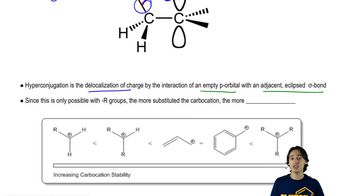
Carbocation Stability

Carbocation stability is a key factor in S_N 1 reactions, as more stable carbocations are formed from tertiary or resonance-stabilized substrates. The efficiency of the S_N 1 reaction in synthesizing ethers is limited because the formation of a stable carbocation can be slow, and if the carbocation is not sufficiently stable, it may lead to rearrangements or side reactions, reducing the yield of the desired ether.
Video consigliato:
05:58
Determining Carbocation Stability

Ethers and Their Synthesis

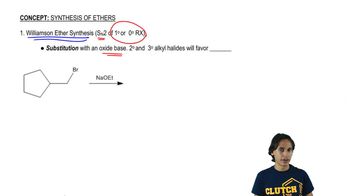
Ethers are organic compounds characterized by an oxygen atom bonded to two alkyl or aryl groups. The synthesis of ethers typically requires more efficient methods, such as the Williamson ether synthesis, which involves the reaction of an alkoxide ion with a primary alkyl halide. The S_N 1 mechanism is inefficient for ether synthesis because it can lead to a mixture of products, including alcohols and alkenes, rather than a clean ether product.
Video consigliato:
03:50
The Mechanism of Williamson Ether Synthesis.