Ch. 13 - Alcohols, Ethers and Related Compounds: Substitution and Elimination
Mullins - Organic Chemistry: A Learner Centered Approach 1st Edition
Mullins1st EditionOrganic Chemistry: A Learner Centered ApproachISBN: 9780137566471Non è quello che usi tu?Cambia libro di testo
Capitolo 12, Problema 24c

Predict the product of the following sulfonylation reactions.
(c)

Guida verificata passo dopo passo
1
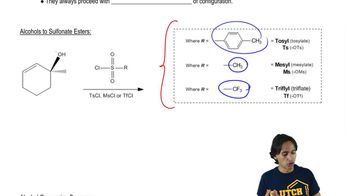
Identify the functional groups in the reactants: The starting material contains an alcohol group (OH) and the reagent is a sulfonyl chloride, specifically a tosyl chloride (p-toluenesulfonyl chloride).
Understand the role of the base: Triethylamine (Et3N) is used as a base to deprotonate the alcohol, making it a better nucleophile.
Predict the nucleophilic attack: The deprotonated alcohol (alkoxide ion) will attack the sulfur atom in the sulfonyl chloride, leading to the displacement of the chloride ion.
Consider the stereochemistry: The reaction will proceed with retention of configuration at the stereocenter where the alcohol group is located, as the sulfonylation does not involve inversion of configuration.
Draw the product: The final product will be an ester-like compound where the alcohol oxygen is now bonded to the sulfur of the tosyl group, forming a tosylate ester. The stereochemistry at the original chiral center is retained.

Risposta video verificata per un problema simile:

Questa soluzione video è stata consigliata dai nostri tutor come utile per risolvere questo problema.

Concetti chiave

Ecco i concetti essenziali che devi comprendere per rispondere correttamente alla domanda.

Sulfonylation

Sulfonylation is a chemical reaction that introduces a sulfonyl group (–SO2–) into a molecule. This process typically involves the reaction of a sulfonyl chloride with an organic compound, often an aromatic ring or an alcohol, leading to the formation of sulfonate esters or sulfonamides. Understanding the mechanism of this reaction is crucial for predicting the products formed.
Video consigliato:
05:33
Learning the mechanism of Sulfonyl Chlorides.

Electrophilic Aromatic Substitution

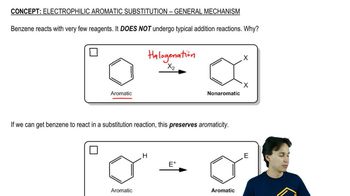
Electrophilic aromatic substitution (EAS) is a fundamental reaction in organic chemistry where an electrophile replaces a hydrogen atom on an aromatic ring. This reaction is essential for understanding how sulfonyl groups can be introduced into aromatic compounds. The stability of the aromatic system and the nature of the substituents influence the reactivity and orientation of the substitution.
Video consigliato:
03:07
EAS Review

Regioselectivity

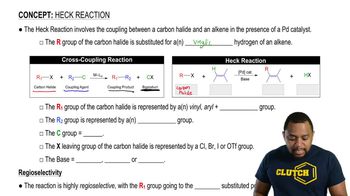
Regioselectivity refers to the preference of a chemical reaction to occur at one location over others in a molecule. In the context of sulfonylation, the position of the sulfonyl group on the aromatic ring can vary based on existing substituents and their electronic effects. Recognizing how these factors influence the regioselectivity is vital for accurately predicting the products of the reaction.
Video consigliato:
05:09
Heck Reaction