Ch. 13 - Alcohols, Ethers and Related Compounds: Substitution and Elimination
Mullins - Organic Chemistry: A Learner Centered Approach 1st Edition
Mullins1st EditionOrganic Chemistry: A Learner Centered ApproachISBN: 9780137566471Non è quello che usi tu?Cambia libro di testo
Capitolo 12, Problema 22

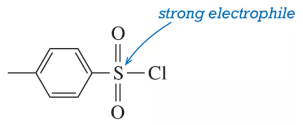
The sulfur atom in toluene sulfonyl chloride (TsCl) is strongly electrophilic. Why?

Guida verificata passo dopo passo
1
Examine the structure of toluene sulfonyl chloride (TsCl). The sulfur atom is bonded to two oxygen atoms, one chlorine atom, and a benzene ring through a sulfonyl group.
Recognize that the sulfur atom in TsCl is part of a sulfonyl group, which is characterized by the presence of two double-bonded oxygen atoms. These oxygen atoms are highly electronegative.
Understand that the electronegative oxygen atoms withdraw electron density from the sulfur atom through resonance and inductive effects, making the sulfur atom electron-deficient.
Consider the role of the chlorine atom, which is also electronegative and can further withdraw electron density from the sulfur atom through inductive effects, enhancing the electrophilicity of the sulfur.
Conclude that the combination of electron-withdrawing effects from the oxygen and chlorine atoms makes the sulfur atom in TsCl a strong electrophile, as it seeks to accept electrons to alleviate its electron deficiency.

Risposta video verificata per un problema simile:

Questa soluzione video è stata consigliata dai nostri tutor come utile per risolvere questo problema.

Concetti chiave

Ecco i concetti essenziali che devi comprendere per rispondere correttamente alla domanda.

Electrophilicity

Electrophilicity refers to the tendency of a species to accept electrons. Electrophiles are typically positively charged or neutral species with an incomplete octet, making them reactive towards nucleophiles. In the case of toluene sulfonyl chloride, the sulfur atom is electrophilic due to its ability to attract electron pairs from nucleophiles, facilitating chemical reactions.
Video consigliato:
03:
Nucleophile or Electrophile

Sulfonyl Chloride Structure

Sulfonyl chlorides, like toluene sulfonyl chloride, contain a sulfonyl group (SO2) bonded to a chlorine atom. The sulfur atom in this group is bonded to two oxygen atoms via double bonds and to a chlorine atom, creating a highly polarized structure. This polarization enhances the electrophilic character of sulfur, making it more susceptible to nucleophilic attack.
Video consigliato:
05:33
Learning the mechanism of Sulfonyl Chlorides.

Resonance Stabilization

Resonance stabilization occurs when a molecule can be represented by multiple valid Lewis structures, leading to a delocalization of electrons. In toluene sulfonyl chloride, the resonance between the sulfur and oxygen atoms allows for the distribution of positive charge, increasing the electrophilicity of the sulfur atom. This delocalization makes the sulfur more reactive towards nucleophiles.
Video consigliato:
03:43
The radical stability trend.