Ch. 13 - Alcohols, Ethers and Related Compounds: Substitution and Elimination
Mullins - Organic Chemistry: A Learner Centered Approach 1st Edition
Mullins1st EditionOrganic Chemistry: A Learner Centered ApproachISBN: 9780137566471Non è quello che usi tu?Cambia libro di testo
Capitolo 12, Problema 106c(i,iii)

Predict the product(s) that would result when molecules (a)–(p) are allowed to react under the following conditions: (i) SOCl₂ ; (iii) SOCl₂, NEt₃. If no reaction occurs, write 'no reaction.'
(c) Chemical structure of a hexagonal ring with two hydroxyl (OH) groups attached to adjacent carbon atoms.

Guida verificata passo dopo passo
1
Identify the functional groups in the given molecule. The structure shows a cyclohexane ring with two hydroxyl groups (OH) attached, indicating it is a diol.
Consider the reaction conditions: (i) SOCl₂ and (iii) SOCl₂, NEt₃. Thionyl chloride (SOCl₂) is commonly used to convert alcohols into alkyl chlorides.
For condition (i) with SOCl₂ alone, each hydroxyl group can be converted into a chloride group. The reaction typically proceeds via an SN2 mechanism, where the hydroxyl group is replaced by a chlorine atom.
For condition (iii) with SOCl₂ and NEt₃ (triethylamine), the presence of a base like NEt₃ helps to neutralize the HCl byproduct and can facilitate the reaction, especially for secondary and tertiary alcohols.
Predict the product: Each hydroxyl group in the diol will be replaced by a chlorine atom, resulting in a dichloride compound. The cyclohexane ring remains unchanged, and the two chlorine atoms will be attached to the same carbon atoms where the hydroxyl groups were originally located.

Risposta video verificata per un problema simile:

Questa soluzione video è stata consigliata dai nostri tutor come utile per risolvere questo problema.

Concetti chiave

Ecco i concetti essenziali che devi comprendere per rispondere correttamente alla domanda.

Thionyl Chloride (SOCl₂) Reactivity

Thionyl chloride is a versatile reagent in organic chemistry, primarily used for converting alcohols into alkyl chlorides. The reaction typically involves the nucleophilic substitution mechanism, where the hydroxyl group is replaced by a chloride ion. Understanding the reactivity of SOCl₂ helps predict the products formed when it reacts with various functional groups.
Video consigliato:
01:36
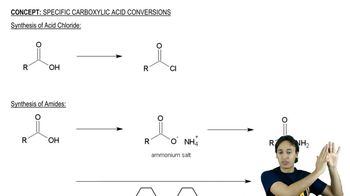
Synthesis of Acid Chlorides

Nucleophilic Substitution Mechanisms

Nucleophilic substitution is a fundamental reaction type in organic chemistry where a nucleophile replaces a leaving group in a molecule. There are two main mechanisms: SN1, which involves a two-step process with a carbocation intermediate, and SN2, which is a one-step process involving a direct attack by the nucleophile. Recognizing which mechanism is favored in a given reaction is crucial for predicting the outcome.
Video consigliato:
01:47
Nucleophiles and Electrophiles can react in Substitution Reactions.

Base Effects in Reactions

The presence of a base, such as triethylamine (NEt₃), can influence the course of a reaction significantly. In the context of reactions with SOCl₂, NEt₃ can act to deprotonate any acidic protons, facilitating the formation of a better leaving group or stabilizing intermediates. Understanding how bases interact with reactants is essential for predicting whether a reaction will proceed and what products will form.
Video consigliato:
Percorso guidato
3:26
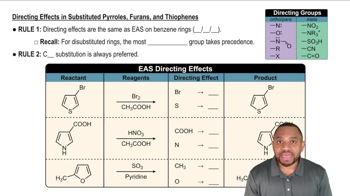
Directing Effects in Substituted Pyrroles, Furans, and Thiophenes Concept 2
Pratica correlata
Domanda del libro di testo

Predict the product(s) that would result when molecules (a)–(p) are allowed to react under the following conditions: (xi) HOCl, H₂O (xii) HIO₄ If no reaction occurs, write 'no reaction.'

(c)

736
views

Domanda del libro di testo

Predict the product(s) that would result when molecules (a)–(p) are allowed to react under the following conditions: (i) SOCl₂ ; (ii) PBr₃ ; (iii) SOCl₂ , NEt₃ (iv) 1. TsCl, Et₃N 2. NaCN; (v) 1. TsCl, Et₃N 2. NaOt-Bu (vi) H₂SO₄ (vii) HCl; (viii) HBr; (ix) PCC; (x) H₂CrO₄ , H₂O (xi) HOCl, H₂O (xii) HIO₄ If no reaction occurs, write 'no reaction.'

(c)

710
views
Domanda del libro di testo

Predict the product(s) that would result when molecules (a)–(p) are allowed to react under the following conditions: (vii) HCl; (viii) HBr. If no reaction occurs, write 'no reaction.'  

(a)

760
views
Domanda del libro di testo

Predict the product(s) that would result when molecules (a)–(p) are allowed to react under the following conditions: (vii) HCl; (viii) HBr; If no reaction occurs, write 'no reaction.'

(c)

563
views
Domanda del libro di testo

Predict the product(s) that would result when molecules (a)–(p) are allowed to react under the following conditions: (i) SOCl₂ ; (ii) PBr₃ ; (iii) SOCl₂ , NEt₃ (iv) 1. TsCl, Et₃N 2. NaCN; (v) 1. TsCl, Et₃N 2. NaOt-Bu (vi) H₂SO₄ (vii) HCl; (viii) HBr; (ix) PCC; (x) H₂CrO₄ , H₂O (xi) HOCl, H₂O (xii) HIO₄ If no reaction occurs, write 'no reaction.'

(c)

743
views
Domanda del libro di testo

Predict the product(s) that would result when molecules (a)–(p) are allowed to react under the following conditions: (iii) SOCl2 , NEt3. If no reaction occurs, write 'no reaction.'  

(a)

445
views