Ch. 13 - Alcohols, Ethers and Related Compounds: Substitution and Elimination
Mullins - Organic Chemistry: A Learner Centered Approach 1st Edition
Mullins1st EditionOrganic Chemistry: A Learner Centered ApproachISBN: 9780137566471Non è quello che usi tu?Cambia libro di testo
Capitolo 12, Problema 106c(xi,xii)

Predict the product(s) that would result when molecules (a)–(p) are allowed to react under the following conditions: (xi) HOCl, H₂O (xii) HIO₄ If no reaction occurs, write 'no reaction.'
(c) Chemical structure of a hexagonal ring with two hydroxyl (OH) groups attached to adjacent carbon atoms.

Guida verificata passo dopo passo
1
Identify the functional groups present in the molecule. In this case, the molecule contains two alcohol groups (OH).
Consider the reaction conditions (xi) HOCl, H₂O. This is a hypochlorous acid in water, which can act as an oxidizing agent. It can convert alcohols to chlorohydrins.
For the reaction with HOCl, H₂O, the secondary alcohol group is more likely to react, forming a chlorohydrin by replacing the OH group with a Cl atom.
Consider the reaction conditions (xii) HIO₄. Periodic acid (HIO₄) is known to cleave vicinal diols (1,2-diols) into aldehydes or ketones.
For the reaction with HIO₄, the vicinal diol (the two adjacent OH groups) will be cleaved, resulting in the formation of two carbonyl compounds, typically ketones or aldehydes, depending on the structure of the original diol.

Risposta video verificata per un problema simile:

Questa soluzione video è stata consigliata dai nostri tutor come utile per risolvere questo problema.

Concetti chiave

Ecco i concetti essenziali che devi comprendere per rispondere correttamente alla domanda.

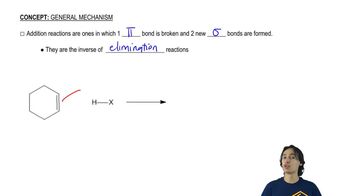
Electrophilic Addition Reactions

Electrophilic addition reactions involve the addition of an electrophile to a nucleophile, typically occurring in alkenes and alkynes. In the context of HOCl and HIO₄, understanding how these reagents interact with double or triple bonds is crucial for predicting the products. The electrophile attacks the nucleophilic site, leading to the formation of new bonds and potentially rearranging the structure of the original molecule.
Video consigliato:
05:39
Features of Addition Mechanisms.

Oxidation-Reduction Reactions

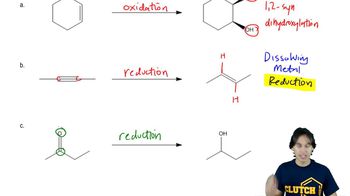
Oxidation-reduction (redox) reactions involve the transfer of electrons between species, resulting in changes in oxidation states. HIO₄ is a strong oxidizing agent that can cleave carbon-carbon bonds and oxidize alcohols to carbonyl compounds. Recognizing whether a reaction leads to oxidation or reduction is essential for predicting the final products of the reactions in question.
Video consigliato:
00:54
Distinguishing between Oxidation and Reduction

Functional Group Transformations

Functional group transformations refer to the chemical reactions that convert one functional group into another. In the reactions with HOCl and HIO₄, it is important to identify the functional groups present in the starting materials and how they may change during the reaction. This understanding helps in predicting the structure of the products formed after the reaction, including any potential rearrangements or eliminations.
Video consigliato:
02:36
Identifying Functional Groups
Pratica correlata
Domanda del libro di testo

Predict the product(s) that would result when molecules (a)–(p) are allowed to react under the following conditions: (ii) PBr₃ If no reaction occurs, write 'no reaction.'

(c)

742
views

Domanda del libro di testo

Predict the product(s) that would result when molecules (a)–(p) are allowed to react under the following conditions: (i) SOCl₂ ; (iii) SOCl₂, NEt₃. If no reaction occurs, write 'no reaction.'

(c)

585
views
Domanda del libro di testo

Predict the product(s) that would result when molecules (a)–(p) are allowed to react under the following conditions: (vi) H₂SO₄. If no reaction occurs, write 'no reaction.'


(c)

684
views
Domanda del libro di testo

Predict the product(s) that would result when molecules (a)–(p) are allowed to react under the following conditions: (i) SOCl₂ ; (ii) PBr₃ ; (iii) SOCl₂ , NEt₃ (iv) 1. TsCl, Et₃N 2. NaCN; (v) 1. TsCl, Et₃N 2. NaOt-Bu (vi) H₂SO₄ (vii) HCl; (viii) HBr; (ix) PCC; (x) H₂CrO₄ , H₂O (xi) HOCl, H₂O (xii) HIO₄ If no reaction occurs, write 'no reaction.'

(c)

710
views
Domanda del libro di testo

Predict the product(s) that would result when molecules (a)–(p) are allowed to react under the following conditions: (vii) HCl; (viii) HBr; If no reaction occurs, write 'no reaction.'

(c)

563
views
Domanda del libro di testo

Predict the product(s) that would result when molecules (a)–(p) are allowed to react under the following conditions: (i) SOCl₂ ; (ii) PBr₃ ; (iii) SOCl₂ , NEt₃ (iv) 1. TsCl, Et₃N 2. NaCN; (v) 1. TsCl, Et₃N 2. NaOt-Bu (vi) H₂SO₄ (vii) HCl; (viii) HBr; (ix) PCC; (x) H₂CrO₄ , H₂O (xi) HOCl, H₂O (xii) HIO₄ If no reaction occurs, write 'no reaction.'

(c)

743
views