Ch. 13 - Alcohols, Ethers and Related Compounds: Substitution and Elimination
Mullins - Organic Chemistry: A Learner Centered Approach 1st Edition
Mullins1st EditionOrganic Chemistry: A Learner Centered ApproachISBN: 9780137566471Non è quello che usi tu?Cambia libro di testo
Capitolo 12, Problema 106c(vi)

Predict the product(s) that would result when molecules (a)–(p) are allowed to react under the following conditions: (vi) H₂SO₄. If no reaction occurs, write 'no reaction.'


(c) Chemical structure of a hexagonal ring with two hydroxyl (OH) groups attached to adjacent carbon atoms.

Guida verificata passo dopo passo
1
Step 1: Identify the functional groups present in the molecule. Look at the structure provided in the image and determine if there are any functional groups that are reactive under acidic conditions, such as alcohols, alkenes, or ethers.
Step 2: Consider the role of H₂SO₄ in organic reactions. Sulfuric acid is a strong acid and can act as a catalyst in dehydration reactions, especially with alcohols, leading to the formation of alkenes.
Step 3: Analyze the molecule for any alcohol groups. If an alcohol group is present, H₂SO₄ can protonate the hydroxyl group, making it a better leaving group and facilitating the formation of a carbocation.
Step 4: Determine if a carbocation rearrangement is possible. Once a carbocation is formed, check if it can rearrange to a more stable carbocation, which is common in reactions involving H₂SO₄.
Step 5: Predict the final product. If the molecule contains an alcohol, the reaction may lead to the formation of an alkene through dehydration. If no reactive functional groups are present, conclude 'no reaction.'

Risposta video verificata per un problema simile:

Questa soluzione video è stata consigliata dai nostri tutor come utile per risolvere questo problema.

Concetti chiave

Ecco i concetti essenziali che devi comprendere per rispondere correttamente alla domanda.

Acid-Base Reactions

In organic chemistry, acid-base reactions involve the transfer of protons (H⁺) between molecules. Strong acids, like sulfuric acid (H₂SO₄), can donate protons to bases, facilitating various reactions such as dehydration or protonation. Understanding the role of acids and bases is crucial for predicting the products of reactions involving H₂SO₄.
Video consigliato:
02:49
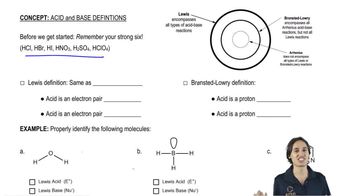
The Lewis definition of acids and bases.

Electrophilic Addition

Electrophilic addition is a fundamental reaction mechanism in organic chemistry where an electrophile reacts with a nucleophile, leading to the formation of a more saturated product. In the presence of H₂SO₄, alkenes can undergo electrophilic addition, where the double bond acts as a nucleophile, reacting with the electrophilic sulfuric acid to form alkyl hydrogen sulfate intermediates.
Video consigliato:
09:23
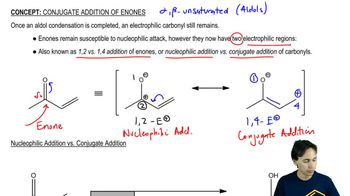
1,2 vs 1,4 Addition

Reaction Conditions and Mechanisms

The conditions under which a reaction occurs significantly influence the mechanism and products formed. In the case of H₂SO₄, the reaction conditions can lead to dehydration, rearrangements, or even no reaction, depending on the structure of the reactants. Analyzing the molecular structure and the reaction environment is essential for accurately predicting the outcome.
Video consigliato:
02:16
Heck Reaction Mechanism
Pratica correlata
Domanda del libro di testo

Predict the product(s) that would result when molecules (a)–(p) are allowed to react under the following conditions: (ii) PBr₃ If no reaction occurs, write 'no reaction.'

(c)

742
views

Domanda del libro di testo

Predict the product(s) that would result when molecules (a)–(p) are allowed to react under the following conditions: (xi) HOCl, H₂O (xii) HIO₄ If no reaction occurs, write 'no reaction.'

(c)

736
views
Domanda del libro di testo

Predict the product(s) that would result when molecules (a)–(p) are allowed to react under the following conditions: (vii) HCl; (viii) HBr; If no reaction occurs, write 'no reaction.'

(f)

744
views
Domanda del libro di testo

Predict the product(s) that would result when molecules (a)–(p) are allowed to react under the following conditions: (vii) HCl; (viii) HBr; If no reaction occurs, write 'no reaction.'

(c)

563
views
Domanda del libro di testo

Predict the product(s) that would result when molecules (a)–(p) are allowed to react under the following conditions: (v) 1. TsCl, Et₃N 2. NaOt-Bu (vi) H₂SO₄ If no reaction occurs, write 'no reaction.'

(f)

730
views
Domanda del libro di testo

Predict the product(s) that would result when molecules (a)–(p) are allowed to react under the following conditions: (i) SOCl₂ ; (ii) PBr₃ ; (iii) SOCl₂ , NEt₃ (iv) 1. TsCl, Et₃N 2. NaCN; (v) 1. TsCl, Et₃N 2. NaOt-Bu (vi) H₂SO₄ (vii) HCl; (viii) HBr; (ix) PCC; (x) H₂CrO₄ , H₂O (xi) HOCl, H₂O (xii) HIO₄ If no reaction occurs, write 'no reaction.'

(c)

743
views