Ch. 13 - Alcohols, Ethers and Related Compounds: Substitution and Elimination
Mullins - Organic Chemistry: A Learner Centered Approach 1st Edition
Mullins1st EditionOrganic Chemistry: A Learner Centered ApproachISBN: 9780137566471Non è quello che usi tu?Cambia libro di testo
Capitolo 12, Problema 14a

Suggest a reagent to carry out each of the following conversions to an alcohol.
(a) Chemical structure showing a chlorine atom converting to an alcohol, with a question mark indicating a missing reagent.

Guida verificata passo dopo passo
1
Step 1: Identify the starting material and the type of reaction required to convert it into an alcohol. For example, if the starting material is an alkene, an addition reaction is needed, whereas if it is a carbonyl compound, a reduction reaction may be required.
Step 2: Determine the specific reagent or set of reagents that can facilitate the conversion. For instance, if the starting material is an alkene, reagents like water (H₂O) and an acid catalyst (e.g., H₂SO₄) can be used for acid-catalyzed hydration. Alternatively, hydroboration-oxidation (BH₃ followed by H₂O₂/NaOH) can also yield an alcohol.
Step 3: If the starting material is a carbonyl compound (e.g., aldehyde or ketone), consider using a reducing agent such as sodium borohydride (NaBH₄) or lithium aluminum hydride (LiAlH₄) to reduce the carbonyl group to an alcohol.
Step 4: For alkyl halides, substitution reactions can be used to form alcohols. A common reagent for this is aqueous sodium hydroxide (NaOH), which facilitates nucleophilic substitution.
Step 5: Once the reagent is selected, ensure that the reaction conditions (e.g., temperature, solvent, and pH) are appropriate for the specific transformation to achieve the desired alcohol product.

Risposta video verificata per un problema simile:

Questa soluzione video è stata consigliata dai nostri tutor come utile per risolvere questo problema.
Durata del video:
4m

Concetti chiave

Ecco i concetti essenziali che devi comprendere per rispondere correttamente alla domanda.

Alcohol Functional Group

Alcohols are organic compounds characterized by the presence of one or more hydroxyl (-OH) groups attached to a carbon atom. Understanding the structure and reactivity of alcohols is crucial, as they can participate in various chemical reactions, including oxidation and substitution, which are often involved in conversions to and from alcohols.
Video consigliato:
02:36
Identifying Functional Groups

Reagents for Alcohol Synthesis

Different reagents can be used to convert various organic compounds into alcohols. Common reagents include reducing agents like lithium aluminum hydride (LiAlH4) or sodium borohydride (NaBH4), which can reduce carbonyl compounds (like aldehydes and ketones) to alcohols. Knowing the appropriate reagent for a specific conversion is essential for successful synthesis.
Video consigliato:
01:37
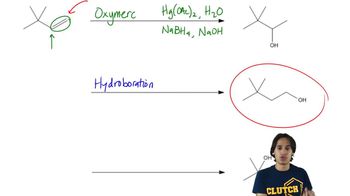
Forming alcohols through Hydroboration-Oxidation.

Mechanisms of Organic Reactions

Understanding the mechanisms of organic reactions is vital for predicting the outcomes of conversions. Mechanisms describe the step-by-step process of how reactants transform into products, including the breaking and forming of bonds. Familiarity with these mechanisms helps in selecting the right reagents and conditions for converting compounds to alcohols.
Video consigliato:
02:17
Identifying organic molecules