Ch. 13 - Alcohols, Ethers and Related Compounds: Substitution and Elimination
Mullins - Organic Chemistry: A Learner Centered Approach 1st Edition
Mullins1st EditionOrganic Chemistry: A Learner Centered ApproachISBN: 9780137566471Non è quello che usi tu?Cambia libro di testo
Capitolo 12, Problema 14b

Suggest a reagent to carry out each of the following conversions to an alcohol.
(b) Chemical reaction diagram showing conversion of an alkene to an alcohol with a question mark indicating missing reagent.

Guida verificata passo dopo passo
1
Identify the starting material and the target alcohol product. Understanding the structure of both will help in selecting the appropriate reagent.
Consider the functional group present in the starting material. Common functional groups that can be converted to alcohols include alkenes, alkyl halides, carbonyl compounds, and esters.
For alkenes, a common method to convert them to alcohols is through hydroboration-oxidation. This involves using a reagent like borane (BH₃) followed by hydrogen peroxide (H₂O₂) in a basic solution.
If the starting material is an alkyl halide, consider using a nucleophilic substitution reaction with a hydroxide ion (OH⁻) to replace the halide with an alcohol group.
For carbonyl compounds such as ketones or aldehydes, reduction reactions using reagents like sodium borohydride (NaBH₄) or lithium aluminum hydride (LiAlH₄) can convert them to alcohols.

Risposta video verificata per un problema simile:

Questa soluzione video è stata consigliata dai nostri tutor come utile per risolvere questo problema.
Durata del video:
3m

Concetti chiave

Ecco i concetti essenziali che devi comprendere per rispondere correttamente alla domanda.

Reduction Reactions

Reduction reactions in organic chemistry involve the gain of electrons or hydrogen atoms, often converting carbonyl compounds to alcohols. Common reducing agents include lithium aluminum hydride (LiAlH4) and sodium borohydride (NaBH4), which are used to reduce aldehydes, ketones, and esters to their corresponding alcohols.
Video consigliato:
07:12
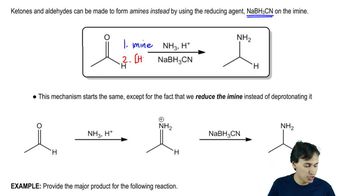
Reductive Amination

Functional Group Transformation

Functional group transformation is a key concept in organic synthesis, where one functional group is converted into another. In the context of converting a compound to an alcohol, understanding the nature of the starting material and the appropriate reagent to facilitate this transformation is crucial for successful synthesis.
Video consigliato:
02:36
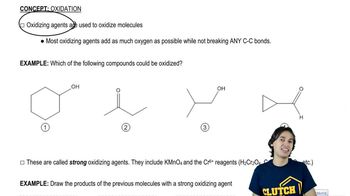
Identifying Functional Groups

Reagent Selection

Reagent selection involves choosing the appropriate chemical substance to achieve a desired chemical transformation. Factors influencing this choice include the reactivity of the reagent, the stability of the intermediate, and the specificity of the reaction. For alcohol synthesis, selecting a suitable reducing agent is essential to ensure efficient conversion without side reactions.
Video consigliato:
01:52
Reagents