Ch. 13 - Alcohols, Ethers and Related Compounds: Substitution and Elimination
Mullins - Organic Chemistry: A Learner Centered Approach 1st Edition
Mullins1st EditionOrganic Chemistry: A Learner Centered ApproachISBN: 9780137566471Non è quello che usi tu?Cambia libro di testo
Capitolo 12, Problema 21d

Which of the following bases would favorably deprotonate a hydroxyl group?
(d) Et3N

Guida verificata passo dopo passo
1
Understand the concept of deprotonation: Deprotonation is the removal of a proton (H⁺) from a molecule, which in this case is a hydroxyl group (OH). The ability of a base to deprotonate a hydroxyl group depends on its strength and the stability of the resulting anion.
Consider the acidity of the hydroxyl group: Hydroxyl groups are generally weak acids, meaning they do not easily lose their proton. Therefore, a strong base is typically required to deprotonate them.
Evaluate the base in question: Triethylamine (Et₃N) is a tertiary amine. Amines are generally considered weak bases compared to other stronger bases like alkoxides or hydroxides.
Compare the base strength: To determine if Et₃N can deprotonate a hydroxyl group, compare its basicity to that of other bases. Strong bases like sodium hydroxide (NaOH) or potassium tert-butoxide (KOtBu) are more likely to deprotonate hydroxyl groups.
Consider steric effects: Triethylamine is a bulky base due to its three ethyl groups, which can hinder its ability to approach and deprotonate the hydroxyl group effectively. This steric hindrance can reduce its effectiveness as a base in deprotonation reactions.

Risposta video verificata per un problema simile:

Questa soluzione video è stata consigliata dai nostri tutor come utile per risolvere questo problema.

Concetti chiave

Ecco i concetti essenziali che devi comprendere per rispondere correttamente alla domanda.

Acid-Base Chemistry

Acid-base chemistry involves the transfer of protons (H⁺) between molecules. A base is a substance that can accept a proton, while an acid is a substance that can donate a proton. Understanding the strength of acids and bases, often measured by pKa values, is crucial for predicting the outcome of deprotonation reactions.
Video consigliato:
02:49
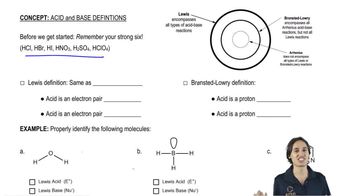
The Lewis definition of acids and bases.

pKa and Deprotonation

The pKa value of a compound indicates its acidity; lower pKa values correspond to stronger acids. Deprotonation occurs when a base removes a proton from an acid. For a base to deprotonate a hydroxyl group effectively, it must be strong enough to overcome the acid's pKa, meaning the base should have a higher affinity for the proton than the hydroxyl group does.
Video consigliato:
07:45
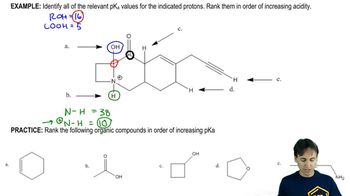
Identifying pKa values

Steric and Electronic Effects

Steric and electronic effects influence a base's ability to deprotonate an acid. Steric hindrance can impede a base's approach to the proton, while electronic effects, such as the presence of electron-donating or withdrawing groups, can stabilize or destabilize the base or the conjugate acid. In the case of triethylamine (Et₃N), steric hindrance from the ethyl groups can affect its basicity and ability to deprotonate a hydroxyl group.
Video consigliato:
02:53
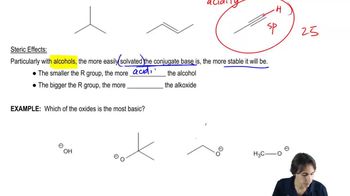
Understanding steric effects.