
Ch. 14 - Structural Identification 1: Infrared Spectroscopy and Mass Spectrometry
Mullins - Organic Chemistry: A Learner Centered Approach 1st Edition
Mullins1st EditionOrganic Chemistry: A Learner Centered ApproachISBN: 9780137566471Non è quello che usi tu?Cambia libro di testo
Capitolo 13, Problema 62b

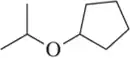
For each of the molecules shown, predict the structure of at least one major fragment in the mass spectrum.
(b) Chemical structure of isopropyl cyclopentyl ether, showing a cyclopentane ring connected to an isopropyl group via an oxygen atom.

Guida verificata passo dopo passo
1
Identify the molecular ion peak (M+) in the mass spectrum, which corresponds to the molecular weight of the compound. This peak is crucial for determining the possible fragments.
Consider the possible cleavage points in the molecule. In organic molecules, common fragmentation patterns include the breaking of C-C bonds, especially those adjacent to functional groups, and the loss of small stable molecules like H2O, CO, or NH3.
Analyze the stability of the potential fragments. More stable carbocations or radicals are more likely to appear as major fragments. For example, tertiary carbocations are more stable than secondary or primary ones.
Use the nitrogen rule, if applicable, to determine the presence of nitrogen in the molecule. This rule states that a molecule with an odd mass number likely contains an odd number of nitrogen atoms.
Predict the structure of the major fragment by considering the most stable cation or radical that can be formed from the molecule. Draw the structure of this fragment, ensuring that it corresponds to a peak in the mass spectrum.

Risposta video verificata per un problema simile:

Questa soluzione video è stata consigliata dai nostri tutor come utile per risolvere questo problema.

Concetti chiave

Ecco i concetti essenziali che devi comprendere per rispondere correttamente alla domanda.

Mass Spectrometry

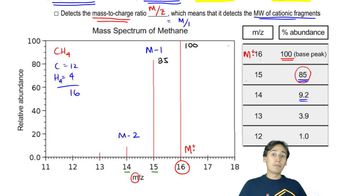
Mass spectrometry is an analytical technique used to measure the mass-to-charge ratio of ions. It helps identify the composition of a sample by generating a mass spectrum, which displays the masses of fragments. Understanding how molecules break apart and form ions is crucial for predicting major fragments in a mass spectrum.
Video consigliato:
01:25
How to Read a Mass Spectrum

Fragmentation Patterns

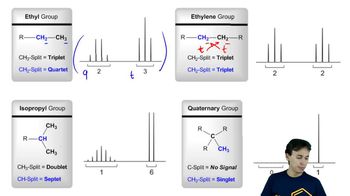
Fragmentation patterns refer to the specific ways in which a molecule breaks apart into smaller ions during mass spectrometry. These patterns are influenced by the molecule's structure and the stability of the resulting fragments. Recognizing common fragmentation pathways, such as cleavage at functional groups, aids in predicting major fragments.
Video consigliato:
08:06
Common Splitting Patterns

Stability of Carbocations

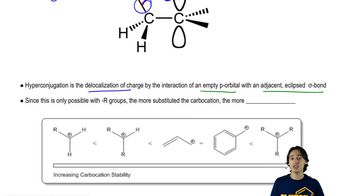
The stability of carbocations plays a significant role in determining fragmentation patterns in mass spectrometry. More stable carbocations, such as tertiary over primary, are more likely to form as major fragments. Understanding the factors that stabilize carbocations, like hyperconjugation and resonance, is essential for predicting which fragments will appear prominently in the spectrum.
Video consigliato:
05:58
Determining Carbocation Stability