Ch. 14 - Structural Identification 1: Infrared Spectroscopy and Mass Spectrometry
Mullins - Organic Chemistry: A Learner Centered Approach 1st Edition
Mullins1st EditionOrganic Chemistry: A Learner Centered ApproachISBN: 9780137566471Non è quello che usi tu?Cambia libro di testo
Capitolo 13, Problema 60a

The first step of a reaction called electrophilic aromatic substitution is as follows:
Diagram illustrating electrophilic aromatic substitution with a benzene derivative, showing the reaction mechanism and substituents.
If this step is rate-determining for the overall reaction, which benzene derivative would you expect to react most quickly? Which would react most slowly?
(a) Benzene derivative with an oxygen substituent, labeled positions 1 and 4, illustrating electrophilic aromatic substitution.

Guida verificata passo dopo passo
1
Identify the substituent on the benzene ring. In the first image, the substituent is labeled as 'X'. In the second image, the substituent is a methoxy group (OCH3).
Understand the role of substituents in electrophilic aromatic substitution (EAS). Substituents can be electron-donating or electron-withdrawing, affecting the reactivity of the benzene ring.
Determine the effect of the substituent on the rate of the reaction. Electron-donating groups (EDGs) like the methoxy group increase the electron density on the benzene ring, making it more reactive towards electrophiles. Electron-withdrawing groups (EWGs) decrease the electron density, making the ring less reactive.
Predict the reactivity based on the substituent. A benzene ring with an electron-donating group will react more quickly in an EAS reaction compared to one with an electron-withdrawing group.
Conclude that the benzene derivative with the methoxy group will react most quickly due to its electron-donating nature, while a benzene derivative with a strong electron-withdrawing group would react most slowly.

Risposta video verificata per un problema simile:

Questa soluzione video è stata consigliata dai nostri tutor come utile per risolvere questo problema.

Concetti chiave

Ecco i concetti essenziali che devi comprendere per rispondere correttamente alla domanda.

Electrophilic Aromatic Substitution (EAS)

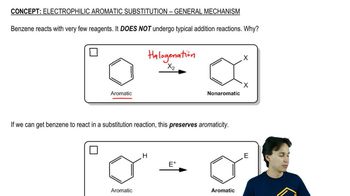
Electrophilic Aromatic Substitution is a fundamental reaction in organic chemistry where an electrophile replaces a hydrogen atom on an aromatic ring. This process typically involves the formation of a sigma complex, where the aromaticity of the ring is temporarily lost. Understanding the mechanism of EAS is crucial for predicting the reactivity of different benzene derivatives based on their substituents.
Video consigliato:
03:07
EAS Review

Substituent Effects on Reactivity

The nature of substituents on a benzene ring significantly influences its reactivity in electrophilic aromatic substitution. Electron-donating groups (EDGs) enhance the electron density of the ring, making it more reactive towards electrophiles, while electron-withdrawing groups (EWGs) decrease reactivity. Recognizing these effects helps in determining which benzene derivative will react more quickly or slowly in EAS.
Video consigliato:
Percorso guidato
3:26
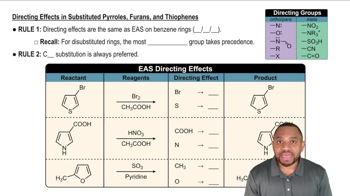
Directing Effects in Substituted Pyrroles, Furans, and Thiophenes Concept 2

Rate-Determining Step

The rate-determining step in a chemical reaction is the slowest step that controls the overall rate of the reaction. In the context of electrophilic aromatic substitution, if the first step is rate-determining, the stability of the intermediate formed and the nature of the substituents will dictate how quickly the reaction proceeds. Analyzing this step is essential for predicting the relative rates of reaction for different benzene derivatives.
Video consigliato:
Percorso guidato
5:07
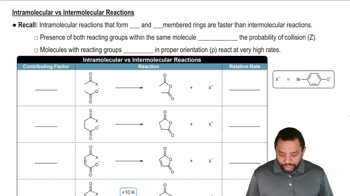
Rates of Intramolecular Reactions Concept 2