Ch. 14 - Structural Identification 1: Infrared Spectroscopy and Mass Spectrometry
Mullins - Organic Chemistry: A Learner Centered Approach 1st Edition
Mullins1st EditionOrganic Chemistry: A Learner Centered ApproachISBN: 9780137566471Non è quello che usi tu?Cambia libro di testo
Capitolo 13, Problema 20d

For each pair, choose the molecule that you expect to have the highest wavenumber for its C=O stretch.
(d) Two molecular structures compared: a six-membered ring with C=O vs. a six-membered ring with C=O and NH.

Guida verificata passo dopo passo
1
Understand that the C=O stretch in infrared spectroscopy is influenced by factors such as bond strength and the surrounding chemical environment. A stronger bond typically results in a higher wavenumber.
Consider the electronic effects on the carbonyl group. Electron-withdrawing groups can increase the bond strength of the C=O bond, leading to a higher wavenumber.
Evaluate the resonance effects. If a molecule has resonance structures that delocalize the electrons away from the carbonyl group, this can weaken the C=O bond and lower the wavenumber.
Assess the steric effects. Bulky groups near the carbonyl can affect the bond angle and length, potentially influencing the wavenumber.
Compare the molecules in the pair based on these factors to determine which one has the stronger C=O bond and thus the higher wavenumber for its C=O stretch.

Risposta video verificata per un problema simile:

Questa soluzione video è stata consigliata dai nostri tutor come utile per risolvere questo problema.

Concetti chiave

Ecco i concetti essenziali che devi comprendere per rispondere correttamente alla domanda.

Infrared Spectroscopy

Infrared spectroscopy is a technique used to identify functional groups in molecules by measuring the absorption of infrared light, which causes molecular vibrations. The C=O stretch is a common feature in IR spectra, typically appearing around 1700 cm⁻¹. The exact position can vary based on molecular environment and bonding.
Video consigliato:
Percorso guidato
2:56
The UV-Vis Spectroscopy Concept 1

Wavenumber and Bond Strength

Wavenumber, measured in cm⁻¹, is inversely related to wavelength and directly related to the energy of the bond vibration. A higher wavenumber indicates a stronger bond, as more energy is required to stretch it. In the context of C=O bonds, factors like resonance, inductive effects, and hybridization can influence bond strength and thus the wavenumber.
Video consigliato:
06:00
Single bonds, double bonds, and triple bonds.

Resonance and Inductive Effects

Resonance and inductive effects can alter the electron density around a C=O bond, affecting its strength and the corresponding IR wavenumber. Resonance can delocalize electrons, often weakening the bond and lowering the wavenumber. Inductive effects, from electronegative atoms or groups, can increase electron withdrawal, strengthening the bond and increasing the wavenumber.
Video consigliato:
01:47
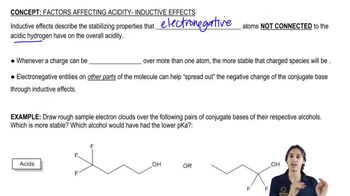
Understanding the Inductive Effect.