Ch. 14 - Structural Identification 1: Infrared Spectroscopy and Mass Spectrometry
Mullins - Organic Chemistry: A Learner Centered Approach 1st Edition
Mullins1st EditionOrganic Chemistry: A Learner Centered ApproachISBN: 9780137566471Non è quello che usi tu?Cambia libro di testo
Capitolo 13, Problema 18a

Would you expect an acetylenic C―H to absorb at a higher or lower wavenumber than the C―H in ethene?
Comparison of acetylenic C―H and ethene C―H bonds with arrows indicating hydrogen positions.

Guida verificata passo dopo passo
1
Understand the concept of wavenumber in IR spectroscopy: Wavenumber is inversely proportional to wavelength and is directly related to the energy of the bond vibration. Higher wavenumbers correspond to higher energy vibrations.
Identify the types of C―H bonds in question: An acetylenic C―H bond is found in alkynes, where the carbon is sp-hybridized. In ethene, the C―H bond is found in alkenes, where the carbon is sp2-hybridized.
Consider the hybridization of the carbon atoms: sp-hybridized carbons (as in alkynes) have more s-character (50%) compared to sp2-hybridized carbons (33% s-character) in alkenes. More s-character results in a stronger, shorter bond.
Relate bond strength to wavenumber: Stronger bonds typically absorb at higher wavenumbers because they require more energy to vibrate.
Conclude based on bond strength and hybridization: Since the acetylenic C―H bond is stronger due to higher s-character, it will absorb at a higher wavenumber compared to the C―H bond in ethene.

Risposta video verificata per un problema simile:

Questa soluzione video è stata consigliata dai nostri tutor come utile per risolvere questo problema.

Concetti chiave

Ecco i concetti essenziali che devi comprendere per rispondere correttamente alla domanda.

Infrared Spectroscopy

Infrared spectroscopy is a technique used to identify functional groups in organic molecules by measuring the absorption of infrared light, which causes molecular vibrations. Different bonds absorb at characteristic wavenumbers, allowing for the identification of specific types of bonds, such as C―H, C=C, and C≡C, based on their unique vibrational frequencies.
Video consigliato:
Percorso guidato
2:56
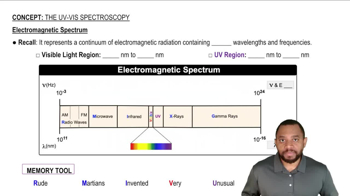
The UV-Vis Spectroscopy Concept 1

Bond Strength and Wavenumber

The wavenumber at which a bond absorbs infrared light is related to the bond strength and the masses of the atoms involved. Stronger bonds, such as triple bonds, typically absorb at higher wavenumbers compared to double or single bonds. This is because stronger bonds require more energy to vibrate, resulting in higher frequency and wavenumber absorption.
Video consigliato:
06:00
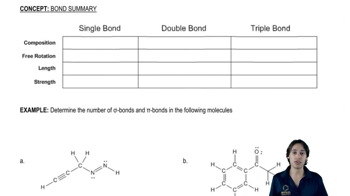
Single bonds, double bonds, and triple bonds.

Acetylenic vs. Ethylenic C―H Bonds

Acetylenic C―H bonds, found in alkynes, are associated with sp-hybridized carbon atoms, while ethylenic C―H bonds, found in alkenes, involve sp2-hybridized carbons. The sp-hybridized C―H bond is stronger and shorter than the sp2-hybridized C―H bond, leading to a higher wavenumber absorption for acetylenic C―H in infrared spectroscopy compared to ethylenic C―H.
Video consigliato:
04:39
Heterolytic vs. Homolytic Bond Cleavage .