Ch. 15 - Structural Identification 2: Nuclear Magnetic Resonance Spectroscopy
Mullins - Organic Chemistry: A Learner Centered Approach 1st Edition
Mullins1st EditionOrganic Chemistry: A Learner Centered ApproachISBN: 9780137566471Non è quello che usi tu?Cambia libro di testo
Capitolo 14, Problema 54b

Draw the expected results of a DEPT sequence for the molecules shown.
(b) Chemical structure of an ether with a propyl group and a terminal alkyne.

Guida verificata passo dopo passo
1
Identify the carbon atoms in the molecule and classify them based on the number of hydrogen atoms attached. In DEPT (Distortionless Enhancement by Polarization Transfer) NMR, carbon atoms are classified as CH3, CH2, CH, or quaternary (C with no hydrogens).
Understand the DEPT sequence: DEPT-90 shows only CH groups, DEPT-135 shows CH and CH3 as positive peaks and CH2 as negative peaks, while quaternary carbons do not appear in any DEPT spectrum.
Analyze the molecular structure to determine the type of each carbon atom. Count the number of hydrogens attached to each carbon to classify them as CH3, CH2, CH, or quaternary.
Draw the DEPT-90 spectrum, indicating only the CH groups. These will appear as positive peaks.
Draw the DEPT-135 spectrum, indicating CH and CH3 groups as positive peaks and CH2 groups as negative peaks. Quaternary carbons will not appear in this spectrum.

Risposta video verificata per un problema simile:

Questa soluzione video è stata consigliata dai nostri tutor come utile per risolvere questo problema.

Concetti chiave

Ecco i concetti essenziali che devi comprendere per rispondere correttamente alla domanda.

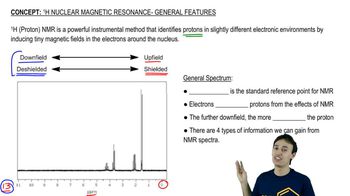
DEPT NMR Spectroscopy

Distortionless Enhancement by Polarization Transfer (DEPT) is a technique in NMR spectroscopy used to determine the number of hydrogen atoms attached to carbon atoms in a molecule. It differentiates between CH, CH2, and CH3 groups by using different pulse sequences, providing a clearer understanding of the molecular structure.
Video consigliato:
10:06
General NMR Features

Carbon-13 NMR

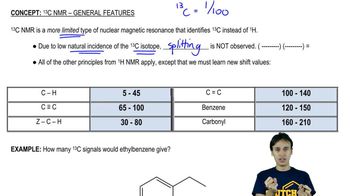
Carbon-13 NMR is a type of nuclear magnetic resonance spectroscopy that focuses on the carbon-13 isotope. It provides information about the carbon skeleton of organic compounds, helping to identify the number and types of carbon environments in a molecule. This technique is crucial for structural elucidation in organic chemistry.
Video consigliato:
04:00
13C NMR General Features

Chemical Shift

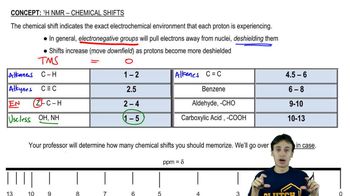
Chemical shift in NMR spectroscopy refers to the resonant frequency of a nucleus relative to a standard in a magnetic field. It provides insights into the electronic environment surrounding the nucleus, influenced by factors like electronegativity and hybridization. Understanding chemical shifts is essential for interpreting NMR spectra and identifying functional groups.
Video consigliato:
11:44
1H NMR Chemical Shifts