Ch. 15 - Structural Identification 2: Nuclear Magnetic Resonance Spectroscopy
Mullins - Organic Chemistry: A Learner Centered Approach 1st Edition
Mullins1st EditionOrganic Chemistry: A Learner Centered ApproachISBN: 9780137566471Non è quello che usi tu?Cambia libro di testo
Capitolo 14, Problema 56

With information from the ¹H NMR and the ¹³C DEPT spectra, structure elucidation becomes even easier. Provide the structure that corresponds to the following data. [The identity of the carbons comes from the DEPT experiment.]
C₆H₁₁BrO₂
IR: 1745 cm ⁻¹
¹H NMR: δ 1.25 (t, 3H), 2.18 (quint, 2H), 2.58 (t, 2H), 3.46 (t, 2H), 4.15 (q, 2H)
¹³C NMR: δ 14.2 (CH₃) , 27.8 (CH₂) , 32.5 (CH₂) , 32.6 (CH₂) , 60.5 (CH₂) , 172.4 (C)

Guida verificata passo dopo passo
1
Identify the functional groups: The IR peak at 1745 cm⁻¹ suggests the presence of a carbonyl group, likely an ester or a ketone.
Analyze the ¹H NMR data: The triplet at δ 1.25 (3H) indicates a methyl group adjacent to a methylene group. The quintet at δ 2.18 (2H) suggests a methylene group flanked by two other groups. The triplet at δ 2.58 (2H) and δ 3.46 (2H) suggest methylene groups adjacent to electronegative atoms or groups. The quartet at δ 4.15 (2H) suggests a methylene group adjacent to an oxygen atom, typical for an ester linkage.
Examine the ¹³C NMR data: The chemical shift at δ 172.4 indicates a carbonyl carbon, supporting the presence of an ester. The other chemical shifts correspond to various CH₃ and CH₂ groups, consistent with the ¹H NMR data.
Consider the molecular formula C₆H₁₁BrO₂: The presence of bromine suggests that one of the methylene groups is likely adjacent to a bromine atom. The formula also supports the presence of an ester group, as indicated by the IR and NMR data.
Propose a structure: Based on the data, propose a structure that includes an ester group, a bromine atom, and the appropriate number of carbon and hydrogen atoms. Consider the connectivity suggested by the NMR data, ensuring that the chemical shifts and splitting patterns are consistent with the proposed structure.

Risposta video verificata per un problema simile:

Questa soluzione video è stata consigliata dai nostri tutor come utile per risolvere questo problema.

Concetti chiave

Ecco i concetti essenziali che devi comprendere per rispondere correttamente alla domanda.

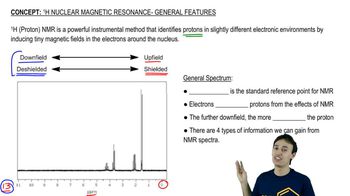
¹H NMR Spectroscopy

¹H NMR spectroscopy is a technique used to determine the structure of organic compounds by analyzing the magnetic environment of hydrogen atoms. The chemical shift (δ) values indicate the type of hydrogen environment, while the splitting pattern (singlet, doublet, triplet, etc.) reveals the number of neighboring hydrogens. In this question, the NMR data provides clues about the connectivity and environment of hydrogen atoms in the molecule.
Video consigliato:
10:06
General NMR Features

¹³C DEPT NMR Spectroscopy

¹³C DEPT (Distortionless Enhancement by Polarization Transfer) NMR spectroscopy is used to differentiate between CH, CH₂, and CH₃ groups in a molecule. It provides information about the carbon skeleton by showing which carbons are bonded to hydrogens. In the given data, DEPT helps identify the types of carbon atoms present, aiding in the construction of the molecular structure.
Video consigliato:
10:06
General NMR Features

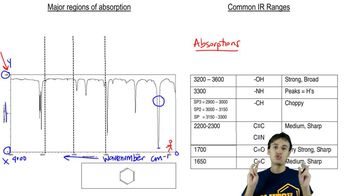
Infrared (IR) Spectroscopy

IR spectroscopy identifies functional groups in a molecule by measuring the absorption of infrared light, which causes molecular vibrations. The absorption at 1745 cm⁻¹ suggests the presence of a carbonyl group (C=O), typically found in esters or ketones. This information, combined with NMR data, helps in deducing the functional groups and overall structure of the compound.
Video consigliato:
16:04
General Features of IR Spect