Ch. 15 - Structural Identification 2: Nuclear Magnetic Resonance Spectroscopy
Mullins - Organic Chemistry: A Learner Centered Approach 1st Edition
Mullins1st EditionOrganic Chemistry: A Learner Centered ApproachISBN: 9780137566471Non è quello che usi tu?Cambia libro di testo
Capitolo 14, Problema 40b

Draw the expected signal for a hydrogen with the following coupling constants.
(b) Hₐ : δ 3.34 (Jₐ꜀ = 9 , Jₐ₆ = 4 )
Chemical structure with labeled hydrogens: Hₐ, Hᵦ, H꜀, showing spin-splitting for NMR analysis.

Guida verificata passo dopo passo
1
Identify the type of hydrogen environment for Hₐ. The chemical shift (δ) at 3.34 ppm suggests it is likely in a deshielded environment, possibly near an electronegative atom or a π-system.
Determine the splitting pattern using the given coupling constants. The coupling constants Jₐ꜀ = 9 Hz and Jₐ₆ = 4 Hz indicate that Hₐ is coupled to two different sets of hydrogens.
Apply the n+1 rule for each coupling constant to predict the splitting pattern. For Jₐ꜀ = 9 Hz, if Hₐ is coupled to n hydrogens, the splitting will be (n+1). Similarly, apply this for Jₐ₆ = 4 Hz.
Combine the splitting patterns from each coupling to determine the overall multiplicity. The signal will be a doublet of doublets (dd) due to the two different coupling constants.
Sketch the expected NMR signal for Hₐ, showing a doublet of doublets with the larger coupling constant (9 Hz) causing the larger separation and the smaller coupling constant (4 Hz) causing the smaller separation within each doublet.

Risposta video verificata per un problema simile:

Questa soluzione video è stata consigliata dai nostri tutor come utile per risolvere questo problema.

Concetti chiave

Ecco i concetti essenziali che devi comprendere per rispondere correttamente alla domanda.

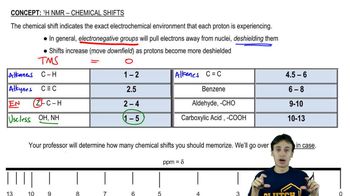
Chemical Shift (δ)

Chemical shift (δ) is a measure of the resonance frequency of a nucleus relative to a standard in a magnetic field. It is expressed in parts per million (ppm) and provides information about the electronic environment surrounding the nucleus. In this question, δ 3.34 indicates the position of the hydrogen signal on the NMR spectrum, suggesting the hydrogen is in a relatively deshielded environment.
Video consigliato:
11:44
1H NMR Chemical Shifts

Coupling Constants (J)

Coupling constants (J) are a measure of the interaction between nuclear spins and are expressed in hertz (Hz). They provide information about the number of neighboring hydrogens and their spatial relationship. In this question, Jₐ꜀ = 9 Hz and Jₐ₆ = 4 Hz indicate the hydrogen is coupled to two different sets of neighboring hydrogens, leading to a splitting pattern in the NMR signal.
Video consigliato:
02:54
Sonogashira Coupling Reaction

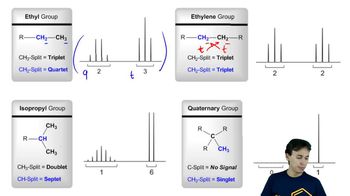
NMR Splitting Patterns

NMR splitting patterns arise from spin-spin coupling between non-equivalent hydrogens. The number of peaks in a splitting pattern is determined by the n+1 rule, where n is the number of neighboring hydrogens. In this case, the hydrogen with coupling constants Jₐ꜀ = 9 Hz and Jₐ₆ = 4 Hz will exhibit a complex splitting pattern, reflecting its interactions with two different sets of neighboring hydrogens.
Video consigliato:
08:06
Common Splitting Patterns