Ch. 15 - Structural Identification 2: Nuclear Magnetic Resonance Spectroscopy
Mullins - Organic Chemistry: A Learner Centered Approach 1st Edition
Mullins1st EditionOrganic Chemistry: A Learner Centered ApproachISBN: 9780137566471Non è quello che usi tu?Cambia libro di testo
Capitolo 14, Problema 42

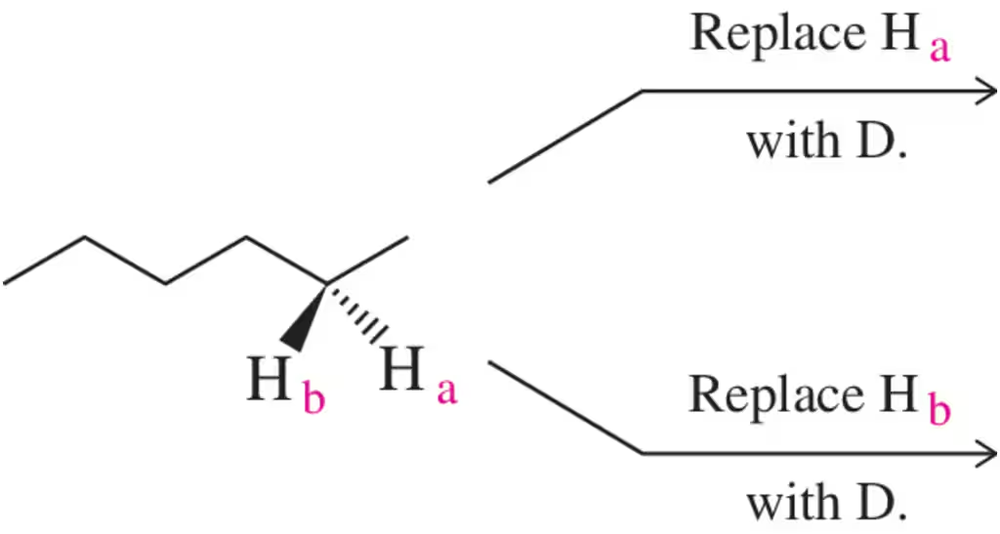
Replace Hₐ and H₆ in hexane with a deuterium. What is the relationship between the two products you obtain? Based on this, would you expect the two hydrogens to give one or two signals in the ¹H NMR spectrum?
Hexane structure showing replacement of Ha and Hb with deuterium, leading to two different products.

Guida verificata passo dopo passo
1
Identify the structure of hexane, which is a linear alkane with the molecular formula C₆H₁₄. It consists of a chain of six carbon atoms with hydrogen atoms filling the remaining valences.
Locate the positions Hₐ and H₆ in the hexane molecule. These are typically the terminal hydrogen atoms on the first and last carbon atoms in the chain.
Replace the hydrogen atom Hₐ on the first carbon with a deuterium atom (D), resulting in a new molecule: C₆H₁₃D. Similarly, replace the hydrogen atom H₆ on the last carbon with a deuterium atom, resulting in another molecule: C₆H₁₃D.
Determine the relationship between the two deuterated products. Since hexane is a symmetrical molecule, replacing Hₐ or H₆ with deuterium results in identical molecules. Therefore, the two products are identical and are considered to be the same compound.
Analyze the ¹H NMR spectrum implications. Since the two hydrogens (Hₐ and H₆) are in equivalent positions in a symmetrical molecule, they are chemically equivalent. Thus, they would give rise to a single signal in the ¹H NMR spectrum.

Risposta video verificata per un problema simile:

Questa soluzione video è stata consigliata dai nostri tutor come utile per risolvere questo problema.

Concetti chiave

Ecco i concetti essenziali che devi comprendere per rispondere correttamente alla domanda.

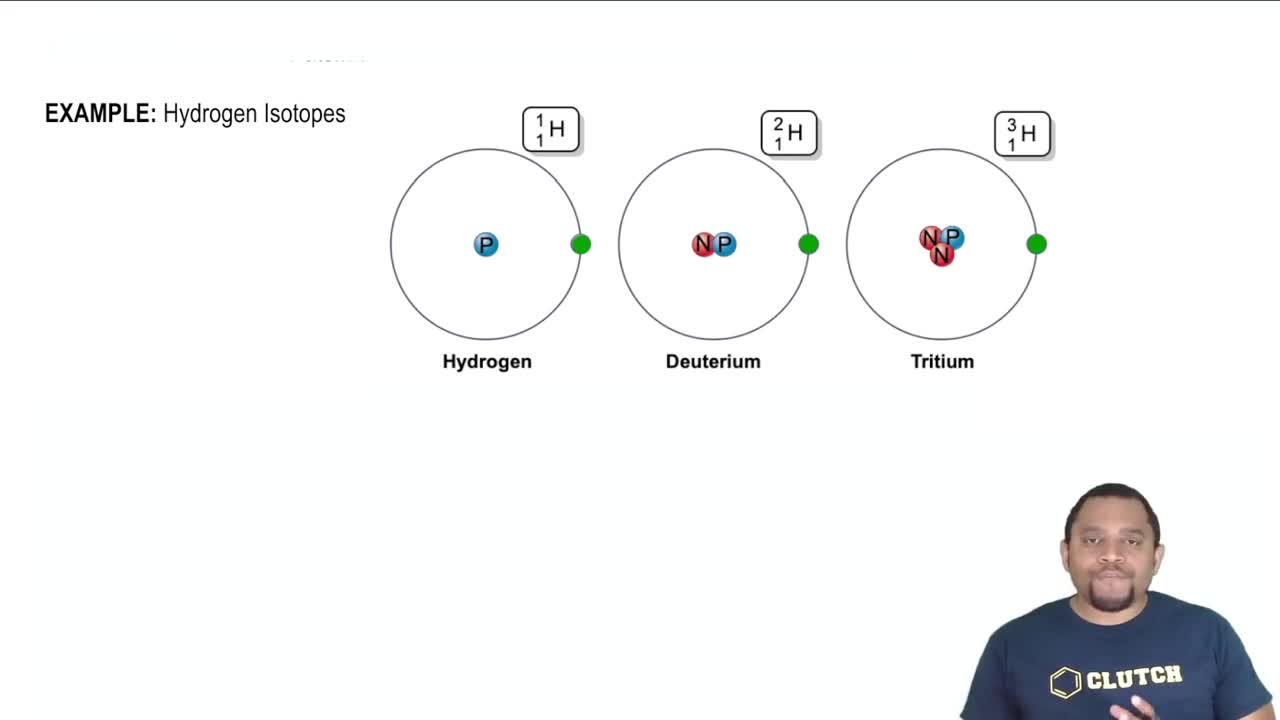
Isotopic Substitution

Isotopic substitution involves replacing an atom in a molecule with one of its isotopes, such as replacing hydrogen (H) with deuterium (D), a heavier isotope of hydrogen. This substitution can affect the physical and chemical properties of the molecule, including its behavior in spectroscopic analysis, due to the difference in mass and nuclear properties between the isotopes.
Video consigliato:
03:06
Understanding the hydrogen isotopes.

Stereochemistry and Chirality

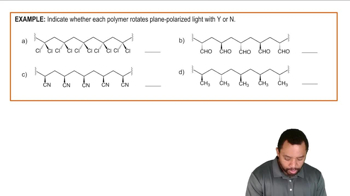
Stereochemistry refers to the spatial arrangement of atoms in molecules and its impact on their chemical behavior. In the context of hexane, replacing two hydrogens with deuterium can create stereoisomers if the replacements occur at chiral centers. These stereoisomers, known as enantiomers or diastereomers, can have different physical properties and may lead to different NMR signals.
Video consigliato:
Percorso guidato
1:21
Polymer Stereochemistry Example 1

¹H NMR Spectroscopy

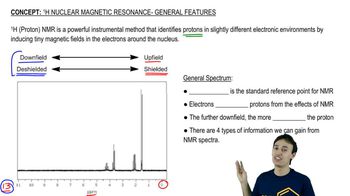
¹H NMR spectroscopy is a technique used to determine the structure of organic compounds by observing the magnetic environment of hydrogen atoms. In NMR, chemically equivalent hydrogens produce a single signal, while non-equivalent hydrogens produce separate signals. The replacement of hydrogens with deuterium can alter the equivalence of hydrogens, potentially leading to changes in the number of signals observed in the spectrum.
Video consigliato:
10:06
General NMR Features