Domanda del libro di testo
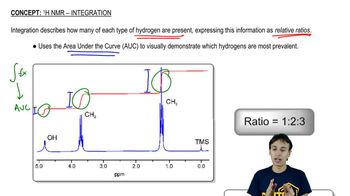
For the following molecules, give the integration you would expect for the signal associated with the hydrogens at the labeled carbons. [Pay attention to the symmetry, or lack of symmetry, in the molecules.]
(c)
1008
views

 Mullins 1st EditionCh. 15 - Structural Identification 2: Nuclear Magnetic Resonance SpectroscopyProblema 58e
 Guida verificata passo dopo passo
 10:06
10:06
 06:46
06:46 00:25
00:25For the following molecules, give the integration you would expect for the signal associated with the hydrogens at the labeled carbons. [Pay attention to the symmetry, or lack of symmetry, in the molecules.]
(c)
For the following molecules, give the integration you would expect for the signal associated with the hydrogens at the labeled carbons. [Pay attention to the symmetry, or lack of symmetry, in the molecules.]
(f)
How many distinct signals would you expect to see in the ¹H NMR spectrum of the following molecules? [Ignore diastereotopic hydrogens for the sake of this assessment.]
(c)
How many distinct signals would you expect to see in the ¹H NMR spectrum of the following molecules? [Ignore diastereotopic hydrogens for the sake of this assessment.]
(f)
For the following molecules, give the chemical shift for each indicated hydrogen.
(b)
For the following molecules, give the chemical shift for each indicated hydrogen.
(d)