Ch. 15 - Structural Identification 2: Nuclear Magnetic Resonance Spectroscopy
Mullins - Organic Chemistry: A Learner Centered Approach 1st Edition
Mullins1st EditionOrganic Chemistry: A Learner Centered ApproachISBN: 9780137566471Non è quello che usi tu?Cambia libro di testo
Capitolo 14, Problema 59b

For the following molecules, give the chemical shift for each indicated hydrogen.
(b) Molecule structure with labeled hydrogens: H3C-CH2-O-CH3, indicating positions for chemical shift analysis.

Guida verificata passo dopo passo
1
Identify the molecular structure and locate the hydrogen atoms for which the chemical shift needs to be determined.
Understand the concept of chemical shift in NMR spectroscopy, which is influenced by the electronic environment surrounding the hydrogen atoms.
Consider the electronic effects such as electronegativity of nearby atoms, hybridization of the carbon atom to which the hydrogen is attached, and any resonance effects that might deshield or shield the hydrogen.
Use typical chemical shift ranges for different types of hydrogen environments: alkane (0.9-1.5 ppm), alkene (4.6-6.0 ppm), aromatic (6.0-8.5 ppm), and others, to estimate the chemical shift.
Compare the hydrogen environments in the molecule to known reference values or tables to assign a chemical shift range for each indicated hydrogen.

Risposta video verificata per un problema simile:

Questa soluzione video è stata consigliata dai nostri tutor come utile per risolvere questo problema.
Durata del video:
4m

Concetti chiave

Ecco i concetti essenziali che devi comprendere per rispondere correttamente alla domanda.

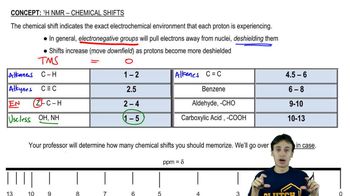
Chemical Shift in NMR Spectroscopy

Chemical shift refers to the resonant frequency of a nucleus relative to a standard in a magnetic field, measured in parts per million (ppm). It provides information about the electronic environment surrounding a nucleus, typically hydrogen in proton NMR. Different chemical environments cause shifts in the resonance frequency, allowing for the identification of functional groups and structural features in a molecule.
Video consigliato:
11:44
1H NMR Chemical Shifts

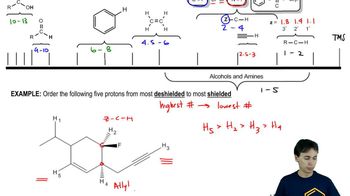
Shielding and Deshielding Effects

Shielding occurs when electron density around a nucleus increases, causing the nucleus to experience a reduced magnetic field and resonate at a higher field (lower ppm). Deshielding is the opposite, where decreased electron density exposes the nucleus to a stronger magnetic field, resulting in a lower field (higher ppm) resonance. These effects are influenced by electronegative atoms, pi bonds, and aromatic rings, which alter the chemical shift.
Video consigliato:
04:18
Ranking Shielded Protons

Functional Group Influence on Chemical Shift

Different functional groups have characteristic chemical shifts due to their distinct electronic environments. For example, hydrogens in alkanes typically resonate between 0-3 ppm, while those in alkenes appear around 4.5-6.5 ppm. Understanding these typical ranges helps predict and interpret the chemical shifts of hydrogens in various molecular contexts, aiding in the structural elucidation of organic compounds.
Video consigliato:
02:36
Identifying Functional Groups