Ch. 15 - Structural Identification 2: Nuclear Magnetic Resonance Spectroscopy
Mullins - Organic Chemistry: A Learner Centered Approach 1st Edition
Mullins1st EditionOrganic Chemistry: A Learner Centered ApproachISBN: 9780137566471Non è quello che usi tu?Cambia libro di testo
Capitolo 14, Problema 60b

Predict the splitting pattern for each of the indicated hydrogens in Assessment 15.59.
(b) Chemical structure showing an ether with labeled hydrogens for spin-splitting analysis: CH3, CH2, and CH3 groups.

Guida verificata passo dopo passo
1
Identify the hydrogen atoms in the molecule that are indicated for analysis. These are the hydrogens whose splitting patterns you need to predict.
Determine the number of neighboring hydrogen atoms for each indicated hydrogen. Remember that neighboring hydrogens are those that are three bonds away, typically on adjacent carbon atoms.
Apply the n+1 rule to predict the splitting pattern for each indicated hydrogen. The n+1 rule states that the number of peaks in the splitting pattern is equal to the number of neighboring hydrogens (n) plus one.
Consider the chemical environment of each indicated hydrogen. Factors such as electronegative atoms or pi bonds nearby can affect the chemical shift and coupling constants, which may influence the splitting pattern.
Summarize the predicted splitting patterns for each indicated hydrogen, taking into account any additional factors that might cause deviations from the simple n+1 rule, such as long-range coupling or equivalent hydrogens.

Risposta video verificata per un problema simile:

Questa soluzione video è stata consigliata dai nostri tutor come utile per risolvere questo problema.

Concetti chiave

Ecco i concetti essenziali che devi comprendere per rispondere correttamente alla domanda.

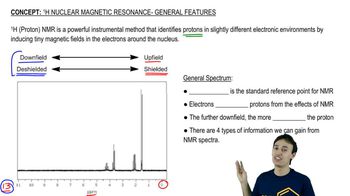
NMR Spectroscopy

Nuclear Magnetic Resonance (NMR) Spectroscopy is a technique used to determine the structure of organic compounds by observing the magnetic properties of certain atomic nuclei. In NMR, the splitting pattern of hydrogen signals provides information about the number of neighboring hydrogen atoms, which helps in deducing the molecular structure.
Video consigliato:
10:06
General NMR Features

Spin-Spin Coupling

Spin-spin coupling, also known as J-coupling, occurs when the magnetic field of one nucleus affects the magnetic field of a neighboring nucleus. This interaction causes the splitting of NMR signals into multiplets, with the number of peaks in a multiplet indicating the number of adjacent hydrogens plus one (n+1 rule).
Video consigliato:
02:54
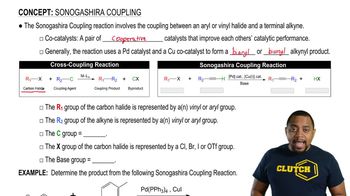
Sonogashira Coupling Reaction

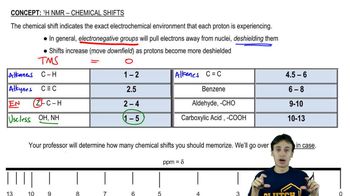
Chemical Shift

Chemical shift in NMR refers to the resonant frequency of a nucleus relative to a standard in a magnetic field. It provides information about the electronic environment surrounding the nucleus. Different chemical environments cause shifts in the resonance frequency, allowing for the identification of different types of hydrogen atoms in a molecule.
Video consigliato:
11:44
1H NMR Chemical Shifts