Ch. 15 - Structural Identification 2: Nuclear Magnetic Resonance Spectroscopy
Mullins - Organic Chemistry: A Learner Centered Approach 1st Edition
Mullins1st EditionOrganic Chemistry: A Learner Centered ApproachISBN: 9780137566471Non è quello che usi tu?Cambia libro di testo
Capitolo 14, Problema 60a

Predict the splitting pattern for each of the indicated hydrogens in Assessment 15.59.
(a) Chemical structure with labeled hydrogens: H1 on CH3, H2 on CH, and H3 on CH3, adjacent to a carbonyl group.

Guida verificata passo dopo passo
1
Identify the hydrogen atoms in the molecule that are being asked about. These are typically labeled or indicated in the problem.
Determine the number of neighboring hydrogen atoms (n) for each indicated hydrogen. This is based on the n+1 rule, where n is the number of neighboring hydrogens.
Apply the n+1 rule to predict the splitting pattern. For example, if an indicated hydrogen has 2 neighboring hydrogens, it will be split into a triplet (2+1=3).
Consider the chemical environment of the indicated hydrogens. Factors such as electronegativity of nearby atoms or groups can affect the chemical shift and splitting pattern.
Review the predicted splitting patterns and ensure they are consistent with the molecular structure and the n+1 rule. Adjust if necessary based on any additional information provided in the problem.

Risposta video verificata per un problema simile:

Questa soluzione video è stata consigliata dai nostri tutor come utile per risolvere questo problema.

Concetti chiave

Ecco i concetti essenziali che devi comprendere per rispondere correttamente alla domanda.

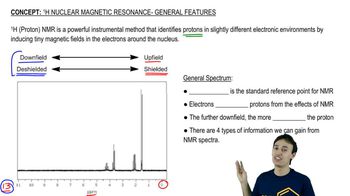
NMR Spectroscopy

Nuclear Magnetic Resonance (NMR) Spectroscopy is a technique used to determine the structure of organic compounds by analyzing the magnetic properties of atomic nuclei. It provides information about the number of hydrogen atoms, their environment, and how they are connected within a molecule, which is crucial for predicting splitting patterns.
Video consigliato:
10:06
General NMR Features

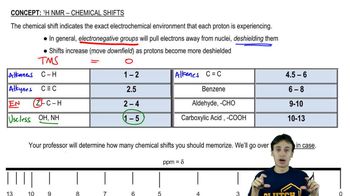
Chemical Shift

Chemical shift refers to the position of an NMR signal relative to a standard reference, indicating the electronic environment of a nucleus. Different chemical environments cause shifts in the resonance frequency, helping to identify the types of hydrogen atoms present and their surroundings, which influences splitting patterns.
Video consigliato:
11:44
1H NMR Chemical Shifts

Spin-Spin Coupling

Spin-spin coupling occurs when magnetic nuclei influence each other's magnetic fields, leading to signal splitting in NMR spectra. The number of peaks in a splitting pattern is determined by the number of neighboring hydrogen atoms, following the n+1 rule, where n is the number of adjacent hydrogens.
Video consigliato:
02:54
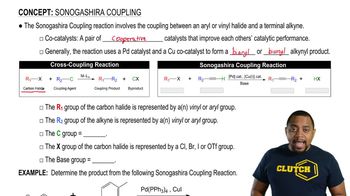
Sonogashira Coupling Reaction